Showing posts with label extinction. Show all posts

Monday, October 12, 2015

Rapid Adaptation

Human pressures have left no ecosystem untouched.  Catastrophists look at the trends and assume they will continue unchecked.  Of course nothing continues unchecked, except maybe black holes and even they are influenced by one another.

One scientists (momentary) inability to repeat his own experiment in coral bleaching serves as an example,

Rosenberg had come to a different conclusion. He’d noticed clumps of rod-shaped bacteria amassed at the borders of bleached regions of corals, suggesting infection. If he first treated the seawater with antibiotics, killing the resident bacteria, and then raised the temperature on corals in tanks, the corals never bleached. Heat alone didn’t drive disease, it seemed. Bacteria somehow contributed. 
He isolated one bacterium called Vibrio shiloi—a distant relative of cholera—that prompted coral disease. It was an opportunist: harmless at normal temperatures, but pathogenic when conditions grew warmer.In 1996, he published his findings in Nature. But now, a decade later, he and his graduate students tried to replicate the experiment, and failed—twice. The vibrio bacterium no longer seemed to cause disease.“The coral had become resistant,” Rosenberg told me. “This was a blow.” 
He began brainstorming possible explanations. Humans and other vertebrates have adaptive immune systems. With exposure to pathogens, our immune systems can learn and remember. When we encounter a pathogen we’ve seen before, we can repel it before it harms us. That’s the principle underlying vaccines. But corals lack an adaptive immune system. They couldn’t gain immunity from prior exposure the same way.

It turns out that just as a disease can move through a population like wildfire, so can a probiotic answer to that infection.  Moreover,the same human cargo ships that transport infections across vast oceans can't also transport probiotic responses to that infection.

Yep, invasive species can be your friend.

Creatures can adapt to changes in their environment not only through the multi-generational result of selection according to our genetic fitness to the environment but in the relatively short amount of time our symbiotic microbes.

Extinction and Evolution
Some researchers make a strong argument that the American microbiom has changed since the 1980's and is one of the forces driving the current obesity epidemic.  Right now it must remain at the level of hypothesis, you could fill hard drives with what we do not know about the microbes living within our digestive tracts.  I can only hope some future oriented surgeon at a research hospital is storing samples for future analysis of change over time.

Life is adaptive.  Yes, mass extinction is a pragmatic concern to those of us who want to see our species succeed over time, but extinction is not the only story at work.  Evolution is the yang to its yin.  From every mass extinction comes a new diversity.  Concern over the loss of the most present equilibrium is, at worst, a pragmatic concern, the equilibrium of the most recent past was good to our species.

Even our attempts to "think globally" are anthropocentric to the core.

But the earth doesn't care if our species succeeds over time.  The universe doesn't care and, ultimately, extinction is unavoidable.  By all means, examine your life and live a life of virtue, but virtue is a good part temperance.  In this case that means not thinking too highly of either yourself or our species.  Even if we make the planet inhabitable for homo sapiens, it has been before and it will be again.

You, the species, even the existence of any form of life on this globe is "only for now."


Wednesday, September 30, 2015

Jurassic Pigeon?

Would we just send them back into the abyss?
I was that seventh grade kid sitting in the back of the room reading the encyclopedia when rain kept us inside during recess.

It was there I was introduced to the passenger pigeon.  After class had reconvened and the teacher droned on about fractions, I was imagining what the sky would look like flooded by their presence.  I wondered what they would sound like as they filled the sky.  I wondered what they tasted like, that would drive so many settlers to kill them by the hundreds.

Conventional wisdom holds that the passenger pigeon was killed for sport and for food.  I am sure this is true, but what if they were also seen as a pest and exterminated as a result?

Reason.com has an article describing their impact on the habitat.
Historically, we know that a giant flock comes into an area, they consume the resources for several hundred square miles, they live in a roosting or nesting site in a tiny spot...and they're so densely crowded into that area that as they come in at night to roost, they're overcrowding branches, snapping branches off of trees, sometimes breaking small trees off at the base as they bend them completely over under their weight. And they're depositing tons of droppings into that area—inches of guano—and that completely, radically changes the biochemistry of the soils. It kills all of the undergrowth that was there, but it also opens up that canopy. All that branch breaking is letting sunlight in. 
Straight into the engine of a 747?
Imagine the impact these birds had on the crops, pastures, and apple orchards of the young nation.  The decline of the passenger pigeon coincided with the settlement of the bird's breeding range.  Perhaps habitat destruction had as much to do with the species' decline as hunting and sport.

The sentiment I experience reading the possibly romanticized story of the passenger pigeon is shared by others.  There is a "De-extinction" program organizing around the idea of collecting their DNA in order to bring them back from the abyss.  The Reason.com article continues,

So you can imagine the next year, when those birds are gone, you get a very thick regenerating underbrush. And that's what these birds were doing. They were stimulating regeneration cycles. And knowing this about the passenger pigeon ecology, we think [bringing them back] is going to be a major benefit for the ecosystems of the future.

The problem is the North American continent no longer exists in an aboriginal state.  You do not have to be a science fiction writer to see how a giant flock of these birds, and a population would probably only be viable as part of a large mass, would conflict with human settlements: suburban housing tracks, dog parks, commercial airports, your local forest preserve.

It brings me no pleasure to say it, the passenger pigeon would be worse than the "rat with wings" in so many urban centers.  America is no longer sparsely populated enough to embrace these poop piranha on wings.  An inch of guano?  If there is a pile of money big enough to compensate those who'd be negatively impacted, I bet we can find better ways to spend it.
Breeding range in red: who wants an inch of poop?


The unspoken assumption is that human beings only send animals into the history books through ignorance and that humanity has moved to a more enlightened state.  Maybe in this case we've romanticized a species based on an incomplete telling of the story?

The loss of the species was a tragedy.  I wish it could have survived in small enough flocks to allow for human cohabitation.  But humans have interests too, and I'd question the assumption that we are any more enlightened than we were a mere four or five generations ago.

While I gave up the idea of individual human sanctification some time ago, the idea that the species as a whole is becoming more enlightened is a faith-based doctrine that has never attracted me.  I mean, have you at least heard of the twentieth century?


We kill because we have a reason to kill them. The habit of killing may last longer than the reason, culture is like that, but there was a reason and there would be again.  Sometimes we can stop ourselves at the precipice of extinction (wolves) but if the passenger pigeon could not co-exist with human habitation the first time, I doubt it would have any better luck a second time around.

Any species brought back from the brink will need to be either limited in ecological impact, or limited in range, and preferably both.   If they make someone some money, that would be even better.  Monied interest would be motivated to find a way to make the new introduction work in a world filled with humans.

The passenger pigeon does not meet that test.

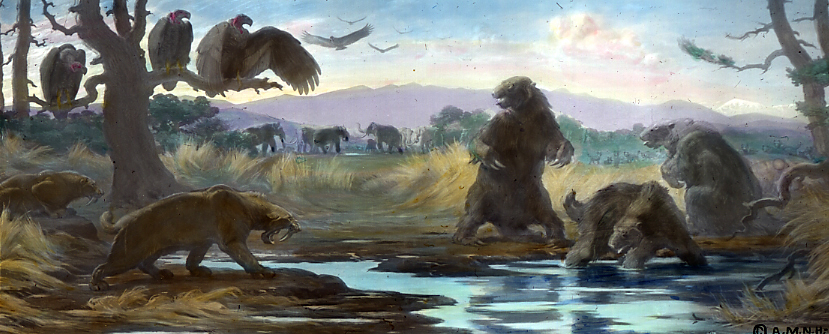
How about a nice giant sloth?  I'm pretty sure we could keep a ground sloth in the national parks and people would pay a pretty penny to see them.