Showing posts with label Anthropocene. Show all posts

Tuesday, December 1, 2015

Walking Pace

A few years ago the I35 bridge in Minneapolis collapsed.  Thirteen people were killed and one hundred and forty-five were injured.

This photo was taken from the east bank, underneath the new bridge that replaced it and you can see a retaining wall failure on the west side of the Mississippi River.  It looks as if the ground underneath the roadway is giving way as well.

These are the kinds of things you notice when you move at a walking pace.


I had just begun to ask myself who I would call to notify of the erosion when I noticed the orange safety barrels at the bottom; someone already knows about the problem.  I decided to trust that someone was monitoring it.

A couple of days later I got a better look from the other side.


This is not the first landslide along the improved banks of the Mississippi.  Why just last year the hillside gave way just outside my workplace.  They still haven't re-opened the roadway beneath it.


The thing is the Mississippi, and all rivers, are not stationary.  They move over time but the things we build do not.  There is a Sapien hubris at work when we build a structure to last two hundred years where the river will want to be in seventy-five.


We may call this era the Anthropocene, but our power is not totalitarian.  Our actions may move the planet one direction or another but the laws of physics are not suspended.

We'd do well to remember.


Monday, October 12, 2015

Rapid Adaptation

Human pressures have left no ecosystem untouched.  Catastrophists look at the trends and assume they will continue unchecked.  Of course nothing continues unchecked, except maybe black holes and even they are influenced by one another.

One scientists (momentary) inability to repeat his own experiment in coral bleaching serves as an example,

Rosenberg had come to a different conclusion. He’d noticed clumps of rod-shaped bacteria amassed at the borders of bleached regions of corals, suggesting infection. If he first treated the seawater with antibiotics, killing the resident bacteria, and then raised the temperature on corals in tanks, the corals never bleached. Heat alone didn’t drive disease, it seemed. Bacteria somehow contributed. 
He isolated one bacterium called Vibrio shiloi—a distant relative of cholera—that prompted coral disease. It was an opportunist: harmless at normal temperatures, but pathogenic when conditions grew warmer.In 1996, he published his findings in Nature. But now, a decade later, he and his graduate students tried to replicate the experiment, and failed—twice. The vibrio bacterium no longer seemed to cause disease.“The coral had become resistant,” Rosenberg told me. “This was a blow.” 
He began brainstorming possible explanations. Humans and other vertebrates have adaptive immune systems. With exposure to pathogens, our immune systems can learn and remember. When we encounter a pathogen we’ve seen before, we can repel it before it harms us. That’s the principle underlying vaccines. But corals lack an adaptive immune system. They couldn’t gain immunity from prior exposure the same way.

It turns out that just as a disease can move through a population like wildfire, so can a probiotic answer to that infection.  Moreover,the same human cargo ships that transport infections across vast oceans can't also transport probiotic responses to that infection.

Yep, invasive species can be your friend.

Creatures can adapt to changes in their environment not only through the multi-generational result of selection according to our genetic fitness to the environment but in the relatively short amount of time our symbiotic microbes.
Extinction and Evolution
Some researchers make a strong argument that the American microbiom has changed since the 1980's and is one of the forces driving the current obesity epidemic.  Right now it must remain at the level of hypothesis, you could fill hard drives with what we do not know about the microbes living within our digestive tracts.  I can only hope some future oriented surgeon at a research hospital is storing samples for future analysis of change over time.

Life is adaptive.  Yes, mass extinction is a pragmatic concern to those of us who want to see our species succeed over time, but extinction is not the only story at work.  Evolution is the yang to its yin.  From every mass extinction comes a new diversity.  Concern over the loss of the most present equilibrium is, at worst, a pragmatic concern, the equilibrium of the most recent past was good to our species.

Even our attempts to "think globally" are anthropocentric to the core.

But the earth doesn't care if our species succeeds over time.  The universe doesn't care and, ultimately, extinction is unavoidable.  By all means, examine your life and live a life of virtue, but virtue is a good part temperance.  In this case that means not thinking too highly of either yourself or our species.  Even if we make the planet inhabitable for homo sapiens, it has been before and it will be again.

You, the species, even the existence of any form of life on this globe is "only for now."


Thursday, October 8, 2015

Moose Rescued

When homo sapiens ascended to the driving force of global ecosystems, we entered a new age, the Anthropocene.  We are no longer living off the natural order, we are managing it. That means sometimes we rescue, sometimes we hunt.

Prudence is the mother of the virtues.


Moose Rescue
MOOSE RESCUED IN NORTHERN WIOn Sept. 24, Canadian Railroad staff noticed a moose entangled in wire near a train track outside Phillips, WI. Railroad staff contacted DNR. With the help of the U.S Department of Agriculture Wildlife Services, they and our staff immobilized the moose and removed the wire. Within an hour, the moose was freed, allowed to roam once again.
Posted by Wisconsin Department of Natural Resources on Tuesday, October 6, 2015

Wednesday, October 7, 2015

Perspective

Referring to the current epoch of geological time as the Anthropocene may be a mere act of hubris.  If a comet of adequate size and velocity slams into Paris tomorrow or any time within the next 100,000 years, any future intelligent life on this planet won't recognize it as anything but prelude to what followed.

http://www.economist.com/node/18741749


Apart from interjecting god into the discussion, there is no reason for us to even prefer the current ecological arrangement of the planet. I mean we care because we have done quite well under the current arrangement and are therefore invested in its continuance.  The universe, however, doesn't care.  The earth neither weeps nor rejoices in us.  Philosophically it matters not if the current epoch continues to declines.

Only we care about the outcome of the Anthropocene because, you see, we are the Anthrops.  Ecological concerns come to the forefront of our mind because we live in them, eat from them, and die in them.

I find the concept of the Anthropocene intriguing because it means we finally get a chance to see how sentient human beings really are. While I do not believe we know as much about the world as we claim, we know enough to start making decisions based upon impacts beyond the current lifetime.

Our perspective is better than it has ever been, but will we care?

We have the power to change the globe for good or for ill, will our tribal nature limit our vision?

 Are we, as a species, truly capable of choice, or are we just a bunch of reindeer stripping resources until we starve?

I don't know.  Until recently, however, it would be hard to imagine asking these questions.  It isn't that we lacked agency.  We just lacked the perspective to perceive the impact of our agency. Will perception make a difference?


Wednesday, September 30, 2015

Jurassic Pigeon?

Would we just send them back into the abyss?
I was that seventh grade kid sitting in the back of the room reading the encyclopedia when rain kept us inside during recess.

It was there I was introduced to the passenger pigeon.  After class had reconvened and the teacher droned on about fractions, I was imagining what the sky would look like flooded by their presence.  I wondered what they would sound like as they filled the sky.  I wondered what they tasted like, that would drive so many settlers to kill them by the hundreds.

Conventional wisdom holds that the passenger pigeon was killed for sport and for food.  I am sure this is true, but what if they were also seen as a pest and exterminated as a result?

Reason.com has an article describing their impact on the habitat.
Historically, we know that a giant flock comes into an area, they consume the resources for several hundred square miles, they live in a roosting or nesting site in a tiny spot...and they're so densely crowded into that area that as they come in at night to roost, they're overcrowding branches, snapping branches off of trees, sometimes breaking small trees off at the base as they bend them completely over under their weight. And they're depositing tons of droppings into that area—inches of guano—and that completely, radically changes the biochemistry of the soils. It kills all of the undergrowth that was there, but it also opens up that canopy. All that branch breaking is letting sunlight in. 
Straight into the engine of a 747?
Imagine the impact these birds had on the crops, pastures, and apple orchards of the young nation.  The decline of the passenger pigeon coincided with the settlement of the bird's breeding range.  Perhaps habitat destruction had as much to do with the species' decline as hunting and sport.

The sentiment I experience reading the possibly romanticized story of the passenger pigeon is shared by others.  There is a "De-extinction" program organizing around the idea of collecting their DNA in order to bring them back from the abyss.  The Reason.com article continues,

So you can imagine the next year, when those birds are gone, you get a very thick regenerating underbrush. And that's what these birds were doing. They were stimulating regeneration cycles. And knowing this about the passenger pigeon ecology, we think [bringing them back] is going to be a major benefit for the ecosystems of the future.

The problem is the North American continent no longer exists in an aboriginal state.  You do not have to be a science fiction writer to see how a giant flock of these birds, and a population would probably only be viable as part of a large mass, would conflict with human settlements: suburban housing tracks, dog parks, commercial airports, your local forest preserve.

It brings me no pleasure to say it, the passenger pigeon would be worse than the "rat with wings" in so many urban centers.  America is no longer sparsely populated enough to embrace these poop piranha on wings.  An inch of guano?  If there is a pile of money big enough to compensate those who'd be negatively impacted, I bet we can find better ways to spend it.
Breeding range in red: who wants an inch of poop?


The unspoken assumption is that human beings only send animals into the history books through ignorance and that humanity has moved to a more enlightened state.  Maybe in this case we've romanticized a species based on an incomplete telling of the story?

The loss of the species was a tragedy.  I wish it could have survived in small enough flocks to allow for human cohabitation.  But humans have interests too, and I'd question the assumption that we are any more enlightened than we were a mere four or five generations ago.

While I gave up the idea of individual human sanctification some time ago, the idea that the species as a whole is becoming more enlightened is a faith-based doctrine that has never attracted me.  I mean, have you at least heard of the twentieth century?


We kill because we have a reason to kill them. The habit of killing may last longer than the reason, culture is like that, but there was a reason and there would be again.  Sometimes we can stop ourselves at the precipice of extinction (wolves) but if the passenger pigeon could not co-exist with human habitation the first time, I doubt it would have any better luck a second time around.

Any species brought back from the brink will need to be either limited in ecological impact, or limited in range, and preferably both.   If they make someone some money, that would be even better.  Monied interest would be motivated to find a way to make the new introduction work in a world filled with humans.

The passenger pigeon does not meet that test.

How about a nice giant sloth?  I'm pretty sure we could keep a ground sloth in the national parks and people would pay a pretty penny to see them.


Monday, September 14, 2015

Settling the Estate

There has been a lot of change over the decades, and the past decade more than most.  Change, however, is not the same thing as progress.

If you're sympathetic to the plight of homosexuals in the United States, you've seen progress.  If you subscribe to a Judeo-Christian worldview there has been regress.  The idea of progress, the only way to distinguish it from just ordinary change depends upon a preconceived notion about where we are, or at least ought to be, going.

Then we have the problem of determining the data set you are measuring.

If you are a Christian, Yazidi, or just not radical enough of a Sunni Muslim in Syria, Iraq, or Lebanon, you would say the world is in a state of regress, regardless of how much progress American homosexuals have experienced.


Progress is a Judeo-Christian idea.  Made necessary by progressive revelation, a god who both keeps on writing and disagreeing with himself is the well spring of innovation.  Eventually it was decided this god had a plan and was moving his people toward that plan.
First the Jews, then a splinter group of Jews called Christians.

If we want to set aside a religious worldview and still talk about how to constructively approach the problems we face we'd be wise to apply the observation by economist Thomas Sowell, "There are no solutions, only trade-offs."

TANSTAAFL, "There ain't no such thing as a free lunch."  If you want to achieve change, there will be a cost, usually our ideology.  When we start talking soberly about costs and benefits we are taking a step away from unspoken pre-conceived notions of progress toward an ideal based on more romantic vision than reality.

Reducing global undernourishment is a goal, I hope, we can agree on.  Turning the world into a patchwork of small organic farmers is a romantic vision.  Returning marginal land to a wild state is a goal.   Humanity evolving into a peaceful vegans is a utopian dream.

That secular society has retained the mental habits of thinking in terms of progress but it gets in the way.  Christendom is dead.  Diversity of opinion is deeply rooted in our culture and the Tea Party and Black Lives Matter each have different visions of progress.  It is much more fruitful to talk in terms of individual changes we want to make in society.

Progress is not the only theistic idea to be retained in our secular present.  The idea of the apocalypse continues to make the rounds in one form or another.  One decade we're headed to an ice age, in the next, global warming will cause the oceans to boil, peak oil, Y2K, the population bomb, and on and on.

Yes, climate change is happening.  Yes some of that change is a result of human activity.  The idea that change will result in the apocalypse, however is a faith based jump and I have sat through too many arguments about the rapture to be easily sold; Al Gore's poetic attempt to pull at my heartstrings notwithstanding.

Getting a little greener each year.
God is dead, but we've yet to settle his estate.

Injecting theistic habits of mind into strictly secular debates serves only to make rationale discussion more difficult than it needs to be.

How does this figure into a blog about hunting, fishing, the natural world, farming, and food more generally?  These issues serve as well springs of pseudo-religious thinking.

 The anti-GMO crowd's continues to influence crowds as they attempt to universalize their faith-based food taboo.  Change from GMO could mean yields go up.  Combined with the decreasing rate of population growth this means fewer acres would be required to meet human needs.  Marginal acres could be returned to forest or prairie.  This would be good for carbon reduction, wildlife, rain forests, and the malnourished.  Instead we argue about food taboos and a romantic vision of what farming "should be" instead of what is, we listen to our fears rather than facts.

Because we assume technological progress is the enemy of nature we ignore evidence that land-based plant life is thriving.  The earth is greener now than it was when the first astronauts looked down upon the blue pearl.  This has happen because we have applied high tech to farming not in spite of it.

This is change that should be cause for rejoicing but it is a heresy in certain circles of foodies and environmentalists who put ideology before results.  The ghost of a moralizing god lingers in their arguments.  Their vision of the promised land obscures data that suggests positive change could be found in a direction other than their "one true set" of beliefs.

Global warming apocalyptic thinking leads to shrill calls to subsidize solar or wind power at its current immature state instead of allowing the technology to continue to develop until it is viable on its own. Biofuel nonsense continues to support the idea of ethanol additives to gasoline, tying up 25% of our corn acreage.  Acreage that could be used for soy, wood products, or returned to a natural state.

Apocalyptic thinking also leads the global warming debate to focus on mitigation instead of adaptation.  If we're not all going to die in some Cormac McCarthy deathscape, we'd better get to work adapting our coasts for higher tides.  But having become convinced that what we face is not change but the apocalypse, we're tied up in arguments about whether Canadian oil will enter world markets through the United States or it own Pacific Coast.

The ghost of the holy continues to haunt us but the first step towards exorcising that ghost is to recognize it when it disrupts rational debate.  By watching our language, we manage our thoughts.  We're living in the Anthropocene.  It is time we started acting like it.

Tuesday, September 8, 2015

The Apocalypse is Postponed

or at least one study suggests it may be.

As climate change accelerates ice melt in the Arctic, polar bears may find caribou and snow geese replacing seals as an important food source, shows a recent study published in the journal PLOS ONE. The research, by Linda Gormezano and Robert Rockwell at the American Museum of Natural History, is based on new computations incorporating caloric energy from terrestrial food sources and indicates that the bears' extended stays on land may not be as grim as previously suggested.


In other words, the polar bears probably won't starve to death.  You're fear and anxiety were so much wasted energy.

Everywhere I look I see contemporary man filled with fear and anxiety.  Hence my reticence to emulate to conform to what makes a man "contemporary."

I'd rather be a dinosaur at peace with himself and the world in it than to walk around on eggshells, always afraid to offend, always thinking what it means to be a classical human is offensive.

I kill to eat.
I am a tribal animal.
I am both an individual and member of a communtiy.

Honey badger don't care.  Polar bear don't care.  Wiscur don't care.

That doesn't mean I do not want to be the best human I am capable of being.  Race horses want to win.  Cats want to kill.  I want to emulate the best of what it is to be "man."  I want to embody the classical virtues: courage, temperence, justice, and prudence.

I don't count catastrophic thinking amongst the human virtues.

I don't care if the woman on TV is quoting Dick Cheny trying to make you afraid of Iraqi nuclear weapons, Barak Obama trying to make you afraid of global warming, or the cashier at Best Buy pushing the extended warrenty, they are using fear to sell you something.

Refuse to be sold.  Refuse to be afraid.

Repeat after me,
“I must not fear. Fear is the mind-killer. Fear is the little-death that brings total obliteration. I will face my fear. I will permit it to pass over me and through me. And when it has gone past I will turn the inner eye to see its path. Where the fear has gone there will be nothing. Only I will remain.”


You should not be surprised when the fear peddled to the masses turns out to be 
overblown.  We should not be surprised when it turns out the world will keep on spinning even if the globe warms.


News Flash: Mass Marketing Lies
We will face obstacles in the future and global warming may well be one of them, but don't buy into the fear.  Yes, we will have to let go of some of the things we love, but who lied to you telling you the universe passed without change or loss?

Danger is real.  Fear is in your head. 

Fear is introduced in order to make you irrational, to make you act quickly so you will accept the choices as they are framed to you, so you will buy what is being sold.  Fear never solved a problem, fear never questioned the two false choices being offered.  Critical thought takes place in the absence of fear.

We are driving change on this planet.  That ship has long left the harbor.  It is time to own this fact rather than lament it, to own and adapt to change rather than fear it.  It is time to realize that while we are a key influence, there is much we can not control. 

Change the things we can.
Accept the things we cannot change. 
Wisdom to know the difference.
Homo Sapien: Tribal, Cosmopolitan, Realist, Unafraid

This is the Anthropocene, let's do it rationally and neither hyped up on fear or asleep in front of the television.

So I am glad it looks as if the polar bears will adapt to changes in their enviroment.  I am not surprised, they are survivors.  Just like their fellow apex predator: Homo sapien.

Edit: Oh yeah, and despite what Al Gore predicted, we are well into a period of low hurricane activity.  Though when it returns to normal or goes above (remember to get average will we have as many years with increased activity as subdued activity), I am sure you will hear about; and you will be told to be afraid.

Saturday, August 15, 2015

Wilderness Politics as Rorschach Test

Hard cases might make bad law but they can teach us to ask better questions.

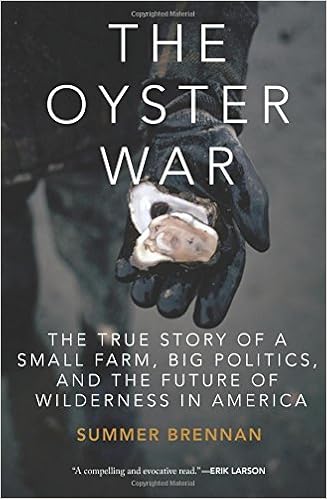
The Oyster War: The True Story of a Small Farm, Big Politics, and the Future of Wilderness in America by Summer Brennan tells the story of farming oysters (introduced from other parts of the world) in California and in doing so breaks open some of the important questions surrounding how we think about wild places.

Disclosure: I am still waiting to read the book.  I followed the story from a distance as it unfolded.  From what I have learned since, I never fully appreciated the passion involved closer to the action.

I highly recommend the podcast of an interview with the author found here or a review of the book here.

Romantic ideas about native and non-natives may have a place in small 
prairies and preserves, but Mediterranean grasses came to California with the first Spanish cattle, violets and bluebells grow alongside native flowers.  

Romantic ideas about returning areas to their pre-contact wildness are also questioned.  Native Americans managed the area in their own way, burning brush and managing prairie to support the local elk population.

Dairymen and cattle farmers were protected when the Point Reyes Wilderness Act became law, the lone oyster farm was not.  Life is sometimes like that.
However we define our ecological goals, they are bound to contain much that is arbitrary and artificial.  We are living in the Anthropocene and human beings are arbitrary.  As a product of evolution ourselves, though, I guess what we do is not technically "artificial" at least no more artificial than the transformation any other invasive species places on its environment.

Meh... I digress.

To the point, ecology is not something static across 
millennium but is always and has always been in flux.  If it has reached a new equilibrium, that should have some value.  If we want to alter the equilibrium or bend it in a new way, that can have value as well.

Let us be honest about this, we are making human decisions based upon human values and s
ometimes all we
are doing is pitting the value 
kayakers place upon an undisturbed ascetic against the value a farmer place upon local place or localvores place on low food-mile oysters.  The science suggests oysters did no harm to the ecology of the place but the idea of farmers in the wilderness ran counter to some perceptions of wilderness.

My reading of the story is that there was enough fault to go around.  Everybody was right.  Everybody was wrong. If you have too strong of an opinion on the matter, it is operating as a 
Rorschach test and telling me more about your internal life than the truth of the matter.


Eventually, however, a society just needs to make a decision.


As someone who is a little bit more concerned with eating than the appearance of an untamed-ness, my sympathies lie with the oyster farmers.  Legally, it appears as if the park service was well within its rights to end the lease of the oyster farmers, despite the fact that science could show no harm was being done.  

Monday, August 3, 2015

Longing to be Compleat

Hello.  My name is Phillip.  I have been asked by my friend Daniel to relate to you, dear reader, some details concerning my favored hobby.  I am an angler.  Using hook and line, I attempt to pull fish from their waters.  I invest many hours of my life, much sweat from my brow, and many dollars from my wallet in this pursuit. Sometimes fruitlessly.

I am participating in this blog to attempt to do something I have not yet been able to do.  Something that may not be, strictly speaking, accomplishable. I want to explain to you why I am an angler. I want to tell you not only how to fish, but why it is a valuable and pleasant exercise, what it can teach you about the world around you, and what it can help a you learn about yourself.

I would like to express what it feels like to be an angler.  Something that I don't think has been done for a very long time.

Since Izaak Walton wrote The Compleat Angler in 1653, there have been very few books on the topic of fishing to have any bearing on literature, or culture.  It is a bit of stretch to suggest that The Compleat Angler has even done this, but it does stick out as a bit of an oddity in the history of publishing.  It is a dialogue about a simple hobby, written by an otherwise unaccomplished author, aimed at a niche audience.  The book is half philosophical musing, half pre-scientific biological observations about fish and their habits.  And yet it is still in print, and has been in print almost continuously since it's first edition.

How did a weird book on an undramatic past time by a second rate writer stay in the collective consciousness?

Most writing on fishing focusses on how to accomplish the task: how to tie knots, how to bait hooks, how to find fish.  Perhaps the writer also waxes poetic on the beauty of this fish, or the scenery, or the artistry required to catch a certain fish.  Or, the writer commits the sin of cliche and exaggerates the drama of the hookset, the fight, the landing of the fish.  Soon, the writer is just another guy bragging about The Big One.

Walton does instruct the reader how to fish, and certainly waxes poetic, and brags on behalf of some of his closest friends.  I guess he sets the mood for all future fisherman in that way.  He also does something more important and more subtle.  Walton fills up most of his reflection on what makes the angler good.

It is important to Walton that angling does not simply pass the time, or put food on the table, or give him a story to relate to his friends.  Angling should also change the person who practices to for the better.  It should help the person cultivate some sort of internal virtues.

I share this sentiment with Walton.  I think that angling has helped me cultivate a variety of virtues, or at least identify the ones in which I am lacking.  And when I think of the best fisherman I know, I also think of some of the finest people I know.  Those possessing the virtues I most admire.

Sadly, Walton's work is long out of date.  Walton's Compleat Angler is a portrait of a man who has not existed for hundreds of years.  A man who has never faced a supermarket, or an interstate highway, or a freezer, or a video game, or nylon fishing line, or a mechanical fishing reel.  His fishing methods are baroque.  Most of the species he sought are not to be found outside of England.  His literary references, while charming and often lovely, are obscure and opaque to most modern readers.  The Compleat Angler is less and less accessible, and I fear that the virtues he celebrates will become less and less celebrated.

I cannot claim to be compleat.  I do not possess all of Piscator's virtues.  I have not mastered my craft. But I would like to.  Please, join me in the Anthropocene, and help me discover what it might be to be a Complete Angler in this new time, this new place.

Piscator: Sir, I hope you will not judge my earnestness to be impatience: and for my simplicity, if by that you mean a harmlessness, or that simplicity which was usually found in the primitive Christians, who were, as most Anglers are, quiet men, and followers of peace; men that were so simply wise, as not to sell their consciences to buy riches, and with them vexation and a fear to die; if you mean such simple men as lived in those times when there were fewer lawyers; when men might have had a lordship safely conveyed to them in a piece of parchment no bigger than your hand, though several sheets will not do it safely in this wiser age; I say, Sir, if you take us Anglers to be such simple men as I have spoke of, then myself and those of my profession will be glad to be so understood: But if by simplicity you meant to express a general defect in those that profess and practice the excellent Art of Angling, I hope in time to disabuse you, and make the contrary appear so evidently, that if you will but have patience to hear me, I shall remove all the anticipations that discourse, or time, or prejudice, have possessed you with against that laudable and ancient Art; for I know it is worthy the knowledge and practice of a wise man.

I will teach you how to fish.  I will teach you how to find fish.  I will occasionally wax poetic.  I will explore the virtues of angling.  All the while, I am sure I will remain incomplete.

Wednesday, July 22, 2015

Introductions

My name is Daniel and I am writing with my friend Phil.  We are members of the Anthropocene and, if you are reading this, so are you.  We are from middle America.  Our wages put us somewhere near "the 50%" of the richest and most advanced civilization in the history of the solar system.  

Philosophically, cosmically, geologically, these facts are pretty irrelevant.  Personally, however, it means that we are freed from the need to act reflexively in order to survive and able to attempt to live reflectively and strive for the varieties of excellence we value.

We share an enjoyment of the outdoors and believe that eating well includes a concern for the welfare and sustainability of the animals and ecosystems which exist around us.  We articulate our concerns differently and our conclusions are not identical.  Our hobbies, passions, and stomping grounds take different turns but they share a rhythm.

This blog is an attempt to give voice to that beat.  It is a discipline for ourselves and, we hope, valuable, or at least entertaining, to others.