Showing posts with label environment. Show all posts

Friday, January 1, 2016

Buy a Duck Stamp

Do you do your hunting with a camera or your eyes?  If the latter, you already buy a license.  If the former, you should do the same.  

North America's wild places are supported in part by fees and licenses paid by sportsmen.

If you love public land, if you support your state DNR, do your part to help keep North America the wild continent that it is.  Buy a fishing license, even if you don't know a walleye from a perch.  Buy a hunting license, even if the only hunting you do is with your senses.

We've got coyotes living in the city.  We've got wolves venturing out of their established habitat.  Those are the good problems to have.  They're not that lucky in Europe.  The difference is the North American model of wildlife conservation.

It's paid for by taxes on firearms, ammunition, and licenses charged to anglers and hunters.  The tax money is distributed to the states based on a formula dependent upon the number of licensed hunters in the state.  Even if you don't own a gun or a bow, you can still support wildlife by buying a license.

Be kind to your web-footed friends.  Buy a duck stamp.
Keep America wild.  Buy a hunting license.

Monday, October 12, 2015

Rapid Adaptation

Human pressures have left no ecosystem untouched.  Catastrophists look at the trends and assume they will continue unchecked.  Of course nothing continues unchecked, except maybe black holes and even they are influenced by one another.

One scientists (momentary) inability to repeat his own experiment in coral bleaching serves as an example,

Rosenberg had come to a different conclusion. He’d noticed clumps of rod-shaped bacteria amassed at the borders of bleached regions of corals, suggesting infection. If he first treated the seawater with antibiotics, killing the resident bacteria, and then raised the temperature on corals in tanks, the corals never bleached. Heat alone didn’t drive disease, it seemed. Bacteria somehow contributed. 
He isolated one bacterium called Vibrio shiloi—a distant relative of cholera—that prompted coral disease. It was an opportunist: harmless at normal temperatures, but pathogenic when conditions grew warmer.In 1996, he published his findings in Nature. But now, a decade later, he and his graduate students tried to replicate the experiment, and failed—twice. The vibrio bacterium no longer seemed to cause disease.“The coral had become resistant,” Rosenberg told me. “This was a blow.” 
He began brainstorming possible explanations. Humans and other vertebrates have adaptive immune systems. With exposure to pathogens, our immune systems can learn and remember. When we encounter a pathogen we’ve seen before, we can repel it before it harms us. That’s the principle underlying vaccines. But corals lack an adaptive immune system. They couldn’t gain immunity from prior exposure the same way.

It turns out that just as a disease can move through a population like wildfire, so can a probiotic answer to that infection.  Moreover,the same human cargo ships that transport infections across vast oceans can't also transport probiotic responses to that infection.

Yep, invasive species can be your friend.

Creatures can adapt to changes in their environment not only through the multi-generational result of selection according to our genetic fitness to the environment but in the relatively short amount of time our symbiotic microbes.
Extinction and Evolution
Some researchers make a strong argument that the American microbiom has changed since the 1980's and is one of the forces driving the current obesity epidemic.  Right now it must remain at the level of hypothesis, you could fill hard drives with what we do not know about the microbes living within our digestive tracts.  I can only hope some future oriented surgeon at a research hospital is storing samples for future analysis of change over time.

Life is adaptive.  Yes, mass extinction is a pragmatic concern to those of us who want to see our species succeed over time, but extinction is not the only story at work.  Evolution is the yang to its yin.  From every mass extinction comes a new diversity.  Concern over the loss of the most present equilibrium is, at worst, a pragmatic concern, the equilibrium of the most recent past was good to our species.

Even our attempts to "think globally" are anthropocentric to the core.

But the earth doesn't care if our species succeeds over time.  The universe doesn't care and, ultimately, extinction is unavoidable.  By all means, examine your life and live a life of virtue, but virtue is a good part temperance.  In this case that means not thinking too highly of either yourself or our species.  Even if we make the planet inhabitable for homo sapiens, it has been before and it will be again.

You, the species, even the existence of any form of life on this globe is "only for now."


Wednesday, September 30, 2015

Jurassic Pigeon?

Would we just send them back into the abyss?
I was that seventh grade kid sitting in the back of the room reading the encyclopedia when rain kept us inside during recess.

It was there I was introduced to the passenger pigeon.  After class had reconvened and the teacher droned on about fractions, I was imagining what the sky would look like flooded by their presence.  I wondered what they would sound like as they filled the sky.  I wondered what they tasted like, that would drive so many settlers to kill them by the hundreds.

Conventional wisdom holds that the passenger pigeon was killed for sport and for food.  I am sure this is true, but what if they were also seen as a pest and exterminated as a result?

Reason.com has an article describing their impact on the habitat.
Historically, we know that a giant flock comes into an area, they consume the resources for several hundred square miles, they live in a roosting or nesting site in a tiny spot...and they're so densely crowded into that area that as they come in at night to roost, they're overcrowding branches, snapping branches off of trees, sometimes breaking small trees off at the base as they bend them completely over under their weight. And they're depositing tons of droppings into that area—inches of guano—and that completely, radically changes the biochemistry of the soils. It kills all of the undergrowth that was there, but it also opens up that canopy. All that branch breaking is letting sunlight in. 
Straight into the engine of a 747?
Imagine the impact these birds had on the crops, pastures, and apple orchards of the young nation.  The decline of the passenger pigeon coincided with the settlement of the bird's breeding range.  Perhaps habitat destruction had as much to do with the species' decline as hunting and sport.

The sentiment I experience reading the possibly romanticized story of the passenger pigeon is shared by others.  There is a "De-extinction" program organizing around the idea of collecting their DNA in order to bring them back from the abyss.  The Reason.com article continues,

So you can imagine the next year, when those birds are gone, you get a very thick regenerating underbrush. And that's what these birds were doing. They were stimulating regeneration cycles. And knowing this about the passenger pigeon ecology, we think [bringing them back] is going to be a major benefit for the ecosystems of the future.

The problem is the North American continent no longer exists in an aboriginal state.  You do not have to be a science fiction writer to see how a giant flock of these birds, and a population would probably only be viable as part of a large mass, would conflict with human settlements: suburban housing tracks, dog parks, commercial airports, your local forest preserve.

It brings me no pleasure to say it, the passenger pigeon would be worse than the "rat with wings" in so many urban centers.  America is no longer sparsely populated enough to embrace these poop piranha on wings.  An inch of guano?  If there is a pile of money big enough to compensate those who'd be negatively impacted, I bet we can find better ways to spend it.
Breeding range in red: who wants an inch of poop?


The unspoken assumption is that human beings only send animals into the history books through ignorance and that humanity has moved to a more enlightened state.  Maybe in this case we've romanticized a species based on an incomplete telling of the story?

The loss of the species was a tragedy.  I wish it could have survived in small enough flocks to allow for human cohabitation.  But humans have interests too, and I'd question the assumption that we are any more enlightened than we were a mere four or five generations ago.

While I gave up the idea of individual human sanctification some time ago, the idea that the species as a whole is becoming more enlightened is a faith-based doctrine that has never attracted me.  I mean, have you at least heard of the twentieth century?


We kill because we have a reason to kill them. The habit of killing may last longer than the reason, culture is like that, but there was a reason and there would be again.  Sometimes we can stop ourselves at the precipice of extinction (wolves) but if the passenger pigeon could not co-exist with human habitation the first time, I doubt it would have any better luck a second time around.

Any species brought back from the brink will need to be either limited in ecological impact, or limited in range, and preferably both.   If they make someone some money, that would be even better.  Monied interest would be motivated to find a way to make the new introduction work in a world filled with humans.

The passenger pigeon does not meet that test.

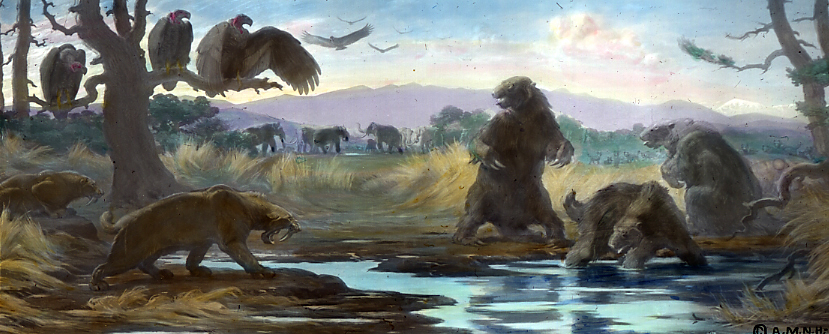
How about a nice giant sloth?  I'm pretty sure we could keep a ground sloth in the national parks and people would pay a pretty penny to see them.


Monday, September 14, 2015

Settling the Estate

There has been a lot of change over the decades, and the past decade more than most.  Change, however, is not the same thing as progress.

If you're sympathetic to the plight of homosexuals in the United States, you've seen progress.  If you subscribe to a Judeo-Christian worldview there has been regress.  The idea of progress, the only way to distinguish it from just ordinary change depends upon a preconceived notion about where we are, or at least ought to be, going.

Then we have the problem of determining the data set you are measuring.

If you are a Christian, Yazidi, or just not radical enough of a Sunni Muslim in Syria, Iraq, or Lebanon, you would say the world is in a state of regress, regardless of how much progress American homosexuals have experienced.


Progress is a Judeo-Christian idea.  Made necessary by progressive revelation, a god who both keeps on writing and disagreeing with himself is the well spring of innovation.  Eventually it was decided this god had a plan and was moving his people toward that plan.
First the Jews, then a splinter group of Jews called Christians.

If we want to set aside a religious worldview and still talk about how to constructively approach the problems we face we'd be wise to apply the observation by economist Thomas Sowell, "There are no solutions, only trade-offs."

TANSTAAFL, "There ain't no such thing as a free lunch."  If you want to achieve change, there will be a cost, usually our ideology.  When we start talking soberly about costs and benefits we are taking a step away from unspoken pre-conceived notions of progress toward an ideal based on more romantic vision than reality.

Reducing global undernourishment is a goal, I hope, we can agree on.  Turning the world into a patchwork of small organic farmers is a romantic vision.  Returning marginal land to a wild state is a goal.   Humanity evolving into a peaceful vegans is a utopian dream.

That secular society has retained the mental habits of thinking in terms of progress but it gets in the way.  Christendom is dead.  Diversity of opinion is deeply rooted in our culture and the Tea Party and Black Lives Matter each have different visions of progress.  It is much more fruitful to talk in terms of individual changes we want to make in society.

Progress is not the only theistic idea to be retained in our secular present.  The idea of the apocalypse continues to make the rounds in one form or another.  One decade we're headed to an ice age, in the next, global warming will cause the oceans to boil, peak oil, Y2K, the population bomb, and on and on.

Yes, climate change is happening.  Yes some of that change is a result of human activity.  The idea that change will result in the apocalypse, however is a faith based jump and I have sat through too many arguments about the rapture to be easily sold; Al Gore's poetic attempt to pull at my heartstrings notwithstanding.

Getting a little greener each year.
God is dead, but we've yet to settle his estate.

Injecting theistic habits of mind into strictly secular debates serves only to make rationale discussion more difficult than it needs to be.

How does this figure into a blog about hunting, fishing, the natural world, farming, and food more generally?  These issues serve as well springs of pseudo-religious thinking.

 The anti-GMO crowd's continues to influence crowds as they attempt to universalize their faith-based food taboo.  Change from GMO could mean yields go up.  Combined with the decreasing rate of population growth this means fewer acres would be required to meet human needs.  Marginal acres could be returned to forest or prairie.  This would be good for carbon reduction, wildlife, rain forests, and the malnourished.  Instead we argue about food taboos and a romantic vision of what farming "should be" instead of what is, we listen to our fears rather than facts.

Because we assume technological progress is the enemy of nature we ignore evidence that land-based plant life is thriving.  The earth is greener now than it was when the first astronauts looked down upon the blue pearl.  This has happen because we have applied high tech to farming not in spite of it.

This is change that should be cause for rejoicing but it is a heresy in certain circles of foodies and environmentalists who put ideology before results.  The ghost of a moralizing god lingers in their arguments.  Their vision of the promised land obscures data that suggests positive change could be found in a direction other than their "one true set" of beliefs.

Global warming apocalyptic thinking leads to shrill calls to subsidize solar or wind power at its current immature state instead of allowing the technology to continue to develop until it is viable on its own. Biofuel nonsense continues to support the idea of ethanol additives to gasoline, tying up 25% of our corn acreage.  Acreage that could be used for soy, wood products, or returned to a natural state.

Apocalyptic thinking also leads the global warming debate to focus on mitigation instead of adaptation.  If we're not all going to die in some Cormac McCarthy deathscape, we'd better get to work adapting our coasts for higher tides.  But having become convinced that what we face is not change but the apocalypse, we're tied up in arguments about whether Canadian oil will enter world markets through the United States or it own Pacific Coast.

The ghost of the holy continues to haunt us but the first step towards exorcising that ghost is to recognize it when it disrupts rational debate.  By watching our language, we manage our thoughts.  We're living in the Anthropocene.  It is time we started acting like it.

Sunday, August 9, 2015

With great power

With great power comes unintended consequences.

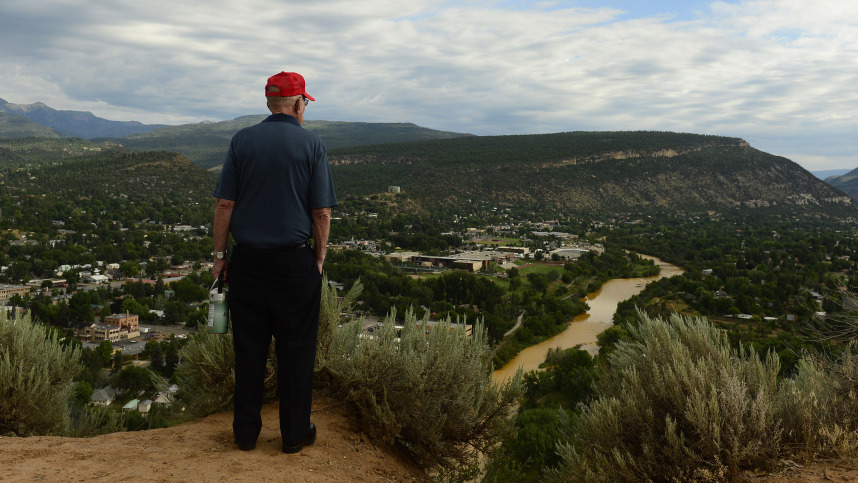
An environmental cleanup of an abandoned mine in the mountains of Colorado went horribly wrong, leading to the spill of one million gallons of contaminated water into a creek that eventually drains into the San Juan River. 
The incident happened when workers for the Environmental Protection Agency were trying to clean the long-abandoned Gold King Mine, but allowed it to breach a berm, or small strip of raised land, and the toxic water flowed into the Animas River. It turned the clear mountain stream a mustard orange color, according to photos posted online. The local sheriff’s office on Aug. 6 closed the river to swimming, kayaking and rafting, and it remained closed Saturday. 
“It’s a sad irony that a program attempting to avoid harm to the environment, appears to have caused it,” said Taylor McKinnon, public lands coordinator for the Center for Biological Diversity, a nonprofit group in Colorado. As the polluted waste moves downstream, “it will dilute, but we don’t know what’s in this water,” McKinnon said. 
According to a statement posted online by the San Juan Basin Health Department, the acidic mine water contains high levels of sediment and metals. Officials warned downstream users to shut off intake valves.