Showing posts with label climate change. Show all posts

Tuesday, February 16, 2016

Hal Lindsey is that You?

Armageddon: only sex sells better.
I've mentioned that when it comes to global warming I am a "Lukewarmist."

Yes, I think global warming is happening.
Yes, I believe that humanity is at least partially responsible as the driver of this phenomenon.
No, I do not think the alarmists know as much as they think they know.

I say this because science is about making predictions and testing the validity of our theories upon whether, how, and when those predictions pan out.  Climate science has a pretty poor track record in this department.

Essentially, it becomes a battle against fundamentalists.  Fundamentalists who believe they are doing what is necessary to save our souls planet.

Tom Hartsford over at Real Clear Science describes the problem better than I can in this recent article.

Predictions are made by building models using the smartest simplifications we have thought of and running them on the most powerful computers ever built. Basically, it's the best we can do right now. 
But there is a major failure of science going on. 
The failure is the lack of transparency and honesty about how feeble these models are and how much we should stake on their all-too-fallible forecasts. Thus the same problem continues: climate science has once again botched a prediction that its models were underequipped to make. 
It seems that there can be no moderate and honest discussion of this issue. Skeptics are singled out in creepy enemies lists. Actually, we're now supposed to call them deniers, as though they were disputing the existence of HIV or the holocaust. Numerous scientists, as well as senators,anti-vaccination Kennedysand clickbait purveyors have even called for the imprisonment and legal prosecution of those who disagree with them. 
Climate science acts like it is fighting a holy war. There are only those who are just and those who must be silenced and stopped at all costs. Anyone who mounts reasonable logical, empirical, or skeptical challenges to the orthodoxy must be ruined, not by counterfactual evidence, but by vicious attack.

The problem is not with the science per sea.  It is a problem of thinly veiled hubris.

Thursday, September 17, 2015

Electrical Power Trade-Offs

Today's problems arise from yesterday's solutions.

I'm don't think global warming is the beginning of the apocalypse, but I do not deny it is among tomorrow's problems and one we should start addressing today.

Solar/Wind powered clothes dryers for the masses.
We recently buried my grandfather.  In his lifetime we went from farming with horses and using well water for refrigeration and barely feeding a world population of 2 billion to the globalization and technological wonders of today amidst a population of 7 billion.

If you're glad you're at a computer this morning and not shoveling horse manure, you've got oil and the internal combustion engine to thank.

I like raising my own meat, and even I am glad that I do not have to make intensively farming my acreage my sole endeavor in life.

We need to deal with today's problems but a return to the past is unacceptable.  Most of the people who advocate it are either ignorant of the past or think that change does not apply to them.  If you believe
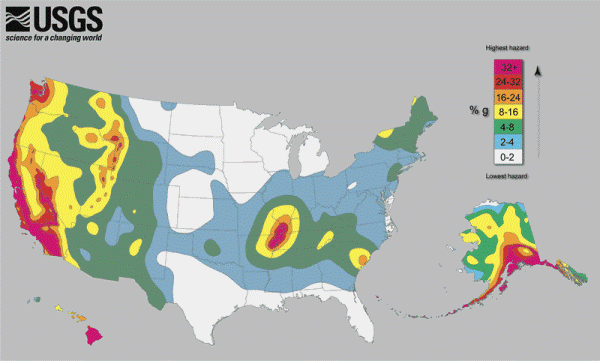
White, blue and green = nuclear
that current solutions will not include their own set of new problems, then you're living in a fantasy.

There are no solutions in this world, only trade-offs.

The best answer I see is that the non-seismic world needs to go nuclear.  Areas of regular or even episodic seismic activity will need to employ a combination of imported electricity from non-seismic areas, natural gas, renewables, and yes, maybe some coal.

Car sharing, electric cars for urban dwellers, smaller and more efficient vehicles for those without a market oriented need for larger ones.  As a whole the globe is already becoming greener, as marginal land is taken out of crop production and returned to either wild or managed forest or prairie.

France and Sweden really are the exemplars,

The Swedes began research to build nuclear reactors in 1962 in a bid to wean the country off burning oil for power as well as to protect rivers from hydroelectric dams. By 1972, the first boiling water reactor at Oskarshamn began tohost fission and churn out electricity. The cost was roughly $1,400 per kilowatt of electric capacity (in 2005 dollars), which is cheap compared to the $7,000 per kilowatt of electric capacity of two new advanced nuclear reactors being built in the U.S. right now. By 1986, with the addition of 11 more reactors, half of Sweden's electricity came from nuclear power and carbon dioxide emissions per Swede had dropped by 75 percent compared to the peak in 1970. 
France, a larger nation, has a similar nuclear tale to tell, weaning itself from imported fossil fuels by building 59 nuclear reactors in the 1970s and 1980s that produce roughly 80 percent of the nation's electricity needs today.

I don't hold out too much hope for fusion, but I am more optimistic about thorium reactors.  Here's the thing,
until there is a market for nuclear power, real private money is not going to be invested in it.  The problem with nuclear is not so much the technical but the political.  Investors will take undertake the work and the expense of making nuclear power as safe as possible.  They will not undertake that risk, however, so long as there lacks the political will to implement any solutions that are engineered.  

The real challenge to nuclear power is neither scientific nor technical, they are political.

The way private space is revolutionizing the cost and scope of human endeavors in space.  Private investment in nuclear will offer a scope of options that the public can then choose from.  They will not offer a cost free solution.  Their solutions will result in new problems we need to address, but they will give us the opportunity to find the best trade-off available to meet the problems of the present at lowest risk to the future.


Monday, September 14, 2015

Settling the Estate

There has been a lot of change over the decades, and the past decade more than most.  Change, however, is not the same thing as progress.

If you're sympathetic to the plight of homosexuals in the United States, you've seen progress.  If you subscribe to a Judeo-Christian worldview there has been regress.  The idea of progress, the only way to distinguish it from just ordinary change depends upon a preconceived notion about where we are, or at least ought to be, going.

Then we have the problem of determining the data set you are measuring.

If you are a Christian, Yazidi, or just not radical enough of a Sunni Muslim in Syria, Iraq, or Lebanon, you would say the world is in a state of regress, regardless of how much progress American homosexuals have experienced.


Progress is a Judeo-Christian idea.  Made necessary by progressive revelation, a god who both keeps on writing and disagreeing with himself is the well spring of innovation.  Eventually it was decided this god had a plan and was moving his people toward that plan.
First the Jews, then a splinter group of Jews called Christians.

If we want to set aside a religious worldview and still talk about how to constructively approach the problems we face we'd be wise to apply the observation by economist Thomas Sowell, "There are no solutions, only trade-offs."

TANSTAAFL, "There ain't no such thing as a free lunch."  If you want to achieve change, there will be a cost, usually our ideology.  When we start talking soberly about costs and benefits we are taking a step away from unspoken pre-conceived notions of progress toward an ideal based on more romantic vision than reality.

Reducing global undernourishment is a goal, I hope, we can agree on.  Turning the world into a patchwork of small organic farmers is a romantic vision.  Returning marginal land to a wild state is a goal.   Humanity evolving into a peaceful vegans is a utopian dream.

That secular society has retained the mental habits of thinking in terms of progress but it gets in the way.  Christendom is dead.  Diversity of opinion is deeply rooted in our culture and the Tea Party and Black Lives Matter each have different visions of progress.  It is much more fruitful to talk in terms of individual changes we want to make in society.

Progress is not the only theistic idea to be retained in our secular present.  The idea of the apocalypse continues to make the rounds in one form or another.  One decade we're headed to an ice age, in the next, global warming will cause the oceans to boil, peak oil, Y2K, the population bomb, and on and on.

Yes, climate change is happening.  Yes some of that change is a result of human activity.  The idea that change will result in the apocalypse, however is a faith based jump and I have sat through too many arguments about the rapture to be easily sold; Al Gore's poetic attempt to pull at my heartstrings notwithstanding.

Getting a little greener each year.
God is dead, but we've yet to settle his estate.

Injecting theistic habits of mind into strictly secular debates serves only to make rationale discussion more difficult than it needs to be.

How does this figure into a blog about hunting, fishing, the natural world, farming, and food more generally?  These issues serve as well springs of pseudo-religious thinking.

 The anti-GMO crowd's continues to influence crowds as they attempt to universalize their faith-based food taboo.  Change from GMO could mean yields go up.  Combined with the decreasing rate of population growth this means fewer acres would be required to meet human needs.  Marginal acres could be returned to forest or prairie.  This would be good for carbon reduction, wildlife, rain forests, and the malnourished.  Instead we argue about food taboos and a romantic vision of what farming "should be" instead of what is, we listen to our fears rather than facts.

Because we assume technological progress is the enemy of nature we ignore evidence that land-based plant life is thriving.  The earth is greener now than it was when the first astronauts looked down upon the blue pearl.  This has happen because we have applied high tech to farming not in spite of it.

This is change that should be cause for rejoicing but it is a heresy in certain circles of foodies and environmentalists who put ideology before results.  The ghost of a moralizing god lingers in their arguments.  Their vision of the promised land obscures data that suggests positive change could be found in a direction other than their "one true set" of beliefs.

Global warming apocalyptic thinking leads to shrill calls to subsidize solar or wind power at its current immature state instead of allowing the technology to continue to develop until it is viable on its own. Biofuel nonsense continues to support the idea of ethanol additives to gasoline, tying up 25% of our corn acreage.  Acreage that could be used for soy, wood products, or returned to a natural state.

Apocalyptic thinking also leads the global warming debate to focus on mitigation instead of adaptation.  If we're not all going to die in some Cormac McCarthy deathscape, we'd better get to work adapting our coasts for higher tides.  But having become convinced that what we face is not change but the apocalypse, we're tied up in arguments about whether Canadian oil will enter world markets through the United States or it own Pacific Coast.

The ghost of the holy continues to haunt us but the first step towards exorcising that ghost is to recognize it when it disrupts rational debate.  By watching our language, we manage our thoughts.  We're living in the Anthropocene.  It is time we started acting like it.
Sunday, August 2, 2015

Say it ain't so Joe!

The BBC travels to coffee producing areas of the world and asks about the impacts of climate change on our favorite caffeinated beverage.  Their findings are more predictable than tomorrow's weather forecast.

Where farmers once enjoyed stable, mild conditions, the temperature now seesaws between cold that stunts growth, and heat that dries the berries before they can be harvested. Then there are the hurricanes and landslides; sometimes, the mud can swallow up plantations. As one farmer put it: “The weather is very strange. Strange things come that we didn’t see before.”

Concerning climate change I would place my own position as among the so-called "Luke-Warmers."  Yes, there is evidence for human generated climate change.  As for the apocalyptic conclusions of some climate change true believers, I remain unconvinced.  The data set available to us is small, I have seen more years of weather than we have satellite measurements and the models scientist have offered have yet to provide predictions born out by observation: the gold standard of science.

To paraphrase the eternal words of Nick Fury, " Until such time as the world ends, I will act as though it intends to spin on."

So about coffee color me yet to be convinced.  The BBC article contains the standard line of logic of most climate change stories to hit the internet,

Using the latest figures for climate change across the globe, Bunn’s calculations predict that the land suited to farming Arabica could drop by as much as 50% by 2050. Classic coffee-producing regions, such as Vietnam, India and most of Central America, will be hit particularly hard.

Again, up until this point those predictions have not proven themselves reliable so I am skeptical about accepting conclusions based upon those models.  


Climate change is real I just don't believe we know enough to claim the apocalypse is upon us. I am fairly confident that it will impact my life and the life of my children.  I know government response to mitigate the threat will impact my life and that of my children. It will have it's own unintended consequences: some of those might be deadly in their own right.

I do not know what percentage of blame for the climate goes to the human contribution of warming gases to the atmosphere and what percentage goes to natural variability.  Either way, I know we do not have some natural right to steady coffee production and the data record for coffee bean cultivation is, in climate terms, shallow.
We're living in the Anthropocene.  No matter how those percentages hash out, we are responsible to react.  I am more optimistic about the possibilities of adapting to climate change than mitigation.  Giving up coffee is an easy adaptation.  Until then, I will worry about problems closer to home.

So while I sit this morning with my cup of french press and cruise the internet, I have 99 worries, but the price of coffee is not one of them.

Frankly, there are 100 things I could do today to make my local ecosystems more resilient to the problems created by the Anthropocene, but nothing I can do to help the coffee growers of the world, except maybe continue to buy their product.


I don't know how much we'll talk about climate change in this blog, as such.  I am fairly confident that you will find what we are doing, however, those one hundred things you can do to adapt to a world which changes from human influence.