Showing posts with label ecology. Show all posts

Thursday, November 5, 2015

Conservation is Conservative

David Peterson calls himself a critic of hunting.  Really, he is a critic of what some of hunting has become: a harvest powered by gadgets, rather than an act empowered by knowledge of the animal you stalk.

I don't think everyone should hunt with a recurve, though I was a bit surprised at the reverence and respect I received when asking about a new string for my recurve at the local Farm and Fleet.

I don't think everyone should ground hunt, but I have learned more in one season of ground hunting than a decade of hunting from a stand.

You get the idea.

I'm not yet the lifelong member of any conservation group and I am only an occassional fisherman, but I am impressed at what some of our local trout people have done to reclaim trout streams.

I'm not sure to whom I should be grateful toward for the ample land open to public access in Wisconsin, but I want to safeguard that tradition.

Yeah, I've got some self-educating to do this winter.

I do know, however, that conservation is conservative.


Wednesday, October 7, 2015

Perspective

Referring to the current epoch of geological time as the Anthropocene may be a mere act of hubris.  If a comet of adequate size and velocity slams into Paris tomorrow or any time within the next 100,000 years, any future intelligent life on this planet won't recognize it as anything but prelude to what followed.

http://www.economist.com/node/18741749


Apart from interjecting god into the discussion, there is no reason for us to even prefer the current ecological arrangement of the planet. I mean we care because we have done quite well under the current arrangement and are therefore invested in its continuance.  The universe, however, doesn't care.  The earth neither weeps nor rejoices in us.  Philosophically it matters not if the current epoch continues to declines.

Only we care about the outcome of the Anthropocene because, you see, we are the Anthrops.  Ecological concerns come to the forefront of our mind because we live in them, eat from them, and die in them.

I find the concept of the Anthropocene intriguing because it means we finally get a chance to see how sentient human beings really are. While I do not believe we know as much about the world as we claim, we know enough to start making decisions based upon impacts beyond the current lifetime.

Our perspective is better than it has ever been, but will we care?

We have the power to change the globe for good or for ill, will our tribal nature limit our vision?

 Are we, as a species, truly capable of choice, or are we just a bunch of reindeer stripping resources until we starve?

I don't know.  Until recently, however, it would be hard to imagine asking these questions.  It isn't that we lacked agency.  We just lacked the perspective to perceive the impact of our agency. Will perception make a difference?


Monday, September 14, 2015

Settling the Estate

There has been a lot of change over the decades, and the past decade more than most.  Change, however, is not the same thing as progress.

If you're sympathetic to the plight of homosexuals in the United States, you've seen progress.  If you subscribe to a Judeo-Christian worldview there has been regress.  The idea of progress, the only way to distinguish it from just ordinary change depends upon a preconceived notion about where we are, or at least ought to be, going.

Then we have the problem of determining the data set you are measuring.

If you are a Christian, Yazidi, or just not radical enough of a Sunni Muslim in Syria, Iraq, or Lebanon, you would say the world is in a state of regress, regardless of how much progress American homosexuals have experienced.


Progress is a Judeo-Christian idea.  Made necessary by progressive revelation, a god who both keeps on writing and disagreeing with himself is the well spring of innovation.  Eventually it was decided this god had a plan and was moving his people toward that plan.
First the Jews, then a splinter group of Jews called Christians.

If we want to set aside a religious worldview and still talk about how to constructively approach the problems we face we'd be wise to apply the observation by economist Thomas Sowell, "There are no solutions, only trade-offs."

TANSTAAFL, "There ain't no such thing as a free lunch."  If you want to achieve change, there will be a cost, usually our ideology.  When we start talking soberly about costs and benefits we are taking a step away from unspoken pre-conceived notions of progress toward an ideal based on more romantic vision than reality.

Reducing global undernourishment is a goal, I hope, we can agree on.  Turning the world into a patchwork of small organic farmers is a romantic vision.  Returning marginal land to a wild state is a goal.   Humanity evolving into a peaceful vegans is a utopian dream.

That secular society has retained the mental habits of thinking in terms of progress but it gets in the way.  Christendom is dead.  Diversity of opinion is deeply rooted in our culture and the Tea Party and Black Lives Matter each have different visions of progress.  It is much more fruitful to talk in terms of individual changes we want to make in society.

Progress is not the only theistic idea to be retained in our secular present.  The idea of the apocalypse continues to make the rounds in one form or another.  One decade we're headed to an ice age, in the next, global warming will cause the oceans to boil, peak oil, Y2K, the population bomb, and on and on.

Yes, climate change is happening.  Yes some of that change is a result of human activity.  The idea that change will result in the apocalypse, however is a faith based jump and I have sat through too many arguments about the rapture to be easily sold; Al Gore's poetic attempt to pull at my heartstrings notwithstanding.

Getting a little greener each year.
God is dead, but we've yet to settle his estate.

Injecting theistic habits of mind into strictly secular debates serves only to make rationale discussion more difficult than it needs to be.

How does this figure into a blog about hunting, fishing, the natural world, farming, and food more generally?  These issues serve as well springs of pseudo-religious thinking.

 The anti-GMO crowd's continues to influence crowds as they attempt to universalize their faith-based food taboo.  Change from GMO could mean yields go up.  Combined with the decreasing rate of population growth this means fewer acres would be required to meet human needs.  Marginal acres could be returned to forest or prairie.  This would be good for carbon reduction, wildlife, rain forests, and the malnourished.  Instead we argue about food taboos and a romantic vision of what farming "should be" instead of what is, we listen to our fears rather than facts.

Because we assume technological progress is the enemy of nature we ignore evidence that land-based plant life is thriving.  The earth is greener now than it was when the first astronauts looked down upon the blue pearl.  This has happen because we have applied high tech to farming not in spite of it.

This is change that should be cause for rejoicing but it is a heresy in certain circles of foodies and environmentalists who put ideology before results.  The ghost of a moralizing god lingers in their arguments.  Their vision of the promised land obscures data that suggests positive change could be found in a direction other than their "one true set" of beliefs.

Global warming apocalyptic thinking leads to shrill calls to subsidize solar or wind power at its current immature state instead of allowing the technology to continue to develop until it is viable on its own. Biofuel nonsense continues to support the idea of ethanol additives to gasoline, tying up 25% of our corn acreage.  Acreage that could be used for soy, wood products, or returned to a natural state.

Apocalyptic thinking also leads the global warming debate to focus on mitigation instead of adaptation.  If we're not all going to die in some Cormac McCarthy deathscape, we'd better get to work adapting our coasts for higher tides.  But having become convinced that what we face is not change but the apocalypse, we're tied up in arguments about whether Canadian oil will enter world markets through the United States or it own Pacific Coast.

The ghost of the holy continues to haunt us but the first step towards exorcising that ghost is to recognize it when it disrupts rational debate.  By watching our language, we manage our thoughts.  We're living in the Anthropocene.  It is time we started acting like it.

Wednesday, August 26, 2015

Spare a coyote and...

My culture, that place where my assumptions meet my actions, has always included the readiness, at a second's notice, to destroy a coyote.


Since the crash which followed the "fur boom" I have only recently known anyone who actively hunted them.  You didn't so much as pursue them. They were more like the unexpected bonus that comes with spending time armed and in the field: always in season and always a possibility.

Now let me be honest, I have never killed one but not for lack of readiness. That I've only taken two shots at them in my life is due to the decades I spent living in cities. But they are the reason why, in my youth, men kept rifles behind the seat of their pickup truck, the reason I kept a broadhead I wasn't afraid to waste in my quiver. You always wanted to be ready to kill a coyote. When we first moved into the country, I was always ready to kill a coyote.


I received this behavior as a man-child from the men who raised me up and it was an expression of the times and assumptions of their ecological passions.   Coyotes will prey on young whitetail deer and the 1960's and 70's were a time when the whitetail deer were returning from the brink and restoring themselves to their natural range.  Coyotes did not appear to serve a purpose and hence to kill a coyote was to save a deer.

That reason to shoot coyotes on sight has outlived its usefulness.


In 2015 whitetail deer populations are more than recovered.  There are quite possibly more deer than is healthy for our natural areas or the long-term health of the species itself.  Coyote predation of young deer is minimal and whatever they do consume is a possible benefit to the population as a whole, not a cost. Some hunters are concerned at the amount of deer hair in coyote scat. Being twice as much the scavenger as the predator it is most likely that the hair came from a road kill or otherwise already dead or dying animal. It takes a lot of energy to take down a healthy deer, very little to kill a sick one, and no energy to eat something already dead. I know what the side of the road looks like around me and the math suggests coyotes are doing more cleaning up than killing.


Spare a coyote, kill a dozen cats, save a hundred birds, feed three foxes...
Secondly, numerous studies are reporting similar findings that the presence of coyotes reduces the feral cat population and restrains the predation of outdoor cats to the immediate vicinity around their homes. In other words, coyotes limit the damage done by outdoor cats.

Wisconsin hunters were right when they saw the threat of feral cats not only to wild bird species but to those native predators, fox, raptors, and owls, which compete with them for mice and voles.  
The feline fundamentalist successfully kept Wisconsin hunters from taking direction action on the threat but there is a backdoor approach open to Wisconsin hunters: promote healthy coyote numbers.

Of course my fur hunting friends should continue their pursuit of pelt and maybe when the winter coat is on, even I will take a shot and bringing home a 'yote, especially if the market value gets high enough. For most of us and the remainder of the year, however, the time has come to give that humble canine fill his own role in the ecosystem, the role of limiting damage done by an invasive species we continue to introduce and protect.


Saturday, August 15, 2015

Wilderness Politics as Rorschach Test

Hard cases might make bad law but they can teach us to ask better questions.

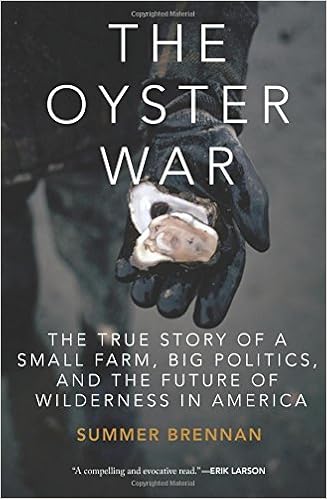
The Oyster War: The True Story of a Small Farm, Big Politics, and the Future of Wilderness in America by Summer Brennan tells the story of farming oysters (introduced from other parts of the world) in California and in doing so breaks open some of the important questions surrounding how we think about wild places.

Disclosure: I am still waiting to read the book.  I followed the story from a distance as it unfolded.  From what I have learned since, I never fully appreciated the passion involved closer to the action.

I highly recommend the podcast of an interview with the author found here or a review of the book here.

Romantic ideas about native and non-natives may have a place in small 
prairies and preserves, but Mediterranean grasses came to California with the first Spanish cattle, violets and bluebells grow alongside native flowers.  

Romantic ideas about returning areas to their pre-contact wildness are also questioned.  Native Americans managed the area in their own way, burning brush and managing prairie to support the local elk population.

Dairymen and cattle farmers were protected when the Point Reyes Wilderness Act became law, the lone oyster farm was not.  Life is sometimes like that.
However we define our ecological goals, they are bound to contain much that is arbitrary and artificial.  We are living in the Anthropocene and human beings are arbitrary.  As a product of evolution ourselves, though, I guess what we do is not technically "artificial" at least no more artificial than the transformation any other invasive species places on its environment.

Meh... I digress.

To the point, ecology is not something static across 
millennium but is always and has always been in flux.  If it has reached a new equilibrium, that should have some value.  If we want to alter the equilibrium or bend it in a new way, that can have value as well.

Let us be honest about this, we are making human decisions based upon human values and s
ometimes all we
are doing is pitting the value 
kayakers place upon an undisturbed ascetic against the value a farmer place upon local place or localvores place on low food-mile oysters.  The science suggests oysters did no harm to the ecology of the place but the idea of farmers in the wilderness ran counter to some perceptions of wilderness.

My reading of the story is that there was enough fault to go around.  Everybody was right.  Everybody was wrong. If you have too strong of an opinion on the matter, it is operating as a 
Rorschach test and telling me more about your internal life than the truth of the matter.


Eventually, however, a society just needs to make a decision.


As someone who is a little bit more concerned with eating than the appearance of an untamed-ness, my sympathies lie with the oyster farmers.  Legally, it appears as if the park service was well within its rights to end the lease of the oyster farmers, despite the fact that science could show no harm was being done.  

Sunday, August 9, 2015

With great power

With great power comes unintended consequences.

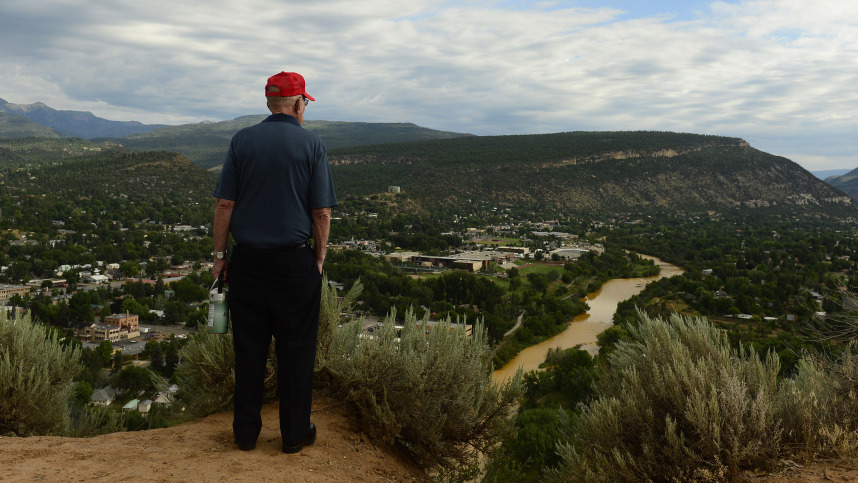
An environmental cleanup of an abandoned mine in the mountains of Colorado went horribly wrong, leading to the spill of one million gallons of contaminated water into a creek that eventually drains into the San Juan River. 
The incident happened when workers for the Environmental Protection Agency were trying to clean the long-abandoned Gold King Mine, but allowed it to breach a berm, or small strip of raised land, and the toxic water flowed into the Animas River. It turned the clear mountain stream a mustard orange color, according to photos posted online. The local sheriff’s office on Aug. 6 closed the river to swimming, kayaking and rafting, and it remained closed Saturday. 
“It’s a sad irony that a program attempting to avoid harm to the environment, appears to have caused it,” said Taylor McKinnon, public lands coordinator for the Center for Biological Diversity, a nonprofit group in Colorado. As the polluted waste moves downstream, “it will dilute, but we don’t know what’s in this water,” McKinnon said. 
According to a statement posted online by the San Juan Basin Health Department, the acidic mine water contains high levels of sediment and metals. Officials warned downstream users to shut off intake valves.


Wednesday, August 5, 2015

Invasive or Under-appreciated?

Have we over-reacted to invasive species? 
Are they something not just to be tolerated buy accepted?

Have our assumptions about ecological stasis led us to some bad assumptions?

Maybe.

I think we have some strange ideas about ecosystems. Ecosystems are constantly changing. There really isn't a native ecosystem anywhere, and certainly if there were any, they've been messed up by humans for a long time.
They are constantly evolving, constantly changing; species are moving in and out. So the whole idea of a pristine, stable, unchanging, natural ecosystem is just getting nature wrong. And an increasing number of ecologists take this line as well.

If we think about species in Australia, for instance, is the dingo a native or an alien? It feels quite native these days, but actually it was brought in from South East Asia a few thousand years ago. It was an early example of humans moving species around the world.

Ecologists often talk about the 21st century as the century in which we encourage nature to recover. ‘Ecological recovery’, ‘ecological restoration’: these are phrases that ecologists talk about a lot. And I'm very much in favour of that, but I don't think we are going to do that just by native species. I think we need the colonists, the species that can do well in damaged environments. And alien species have a real track record of doing that; that's why they survive.


In praise of invasive species

Wednesday, July 22, 2015

Introductions

My name is Daniel and I am writing with my friend Phil.  We are members of the Anthropocene and, if you are reading this, so are you.  We are from middle America.  Our wages put us somewhere near "the 50%" of the richest and most advanced civilization in the history of the solar system.  

Philosophically, cosmically, geologically, these facts are pretty irrelevant.  Personally, however, it means that we are freed from the need to act reflexively in order to survive and able to attempt to live reflectively and strive for the varieties of excellence we value.

We share an enjoyment of the outdoors and believe that eating well includes a concern for the welfare and sustainability of the animals and ecosystems which exist around us.  We articulate our concerns differently and our conclusions are not identical.  Our hobbies, passions, and stomping grounds take different turns but they share a rhythm.

This blog is an attempt to give voice to that beat.  It is a discipline for ourselves and, we hope, valuable, or at least entertaining, to others.