Showing posts with label coyotes. Show all posts

Friday, May 6, 2016

Public Land: Legal Dueling over Dual Use

There was a time when hunters could assume that they had public land to themselves at night.

The expanding nature of dog culture, population increase, and new forms of outdoor recreation mean that is no longer the case.

Case and point, the mistaken killing of two dogs in Badfish Creek Wildlife Area,

Rausch was hunting at night on Jan. 22 in Badfish Creek Wildlife Area, land managed by the Department of Natural Resources, when he used a calling device to attract coyotes and heard animals respond. Rausch told a sheriff’s deputy that he “saw the eyes of what he believed to be a coyote and a face and pointy ears and pulled the trigger. Rausch stated that he did not realize it was a domesticated dog that he had shot.” Rausch also shot a second dog that ran up to him moments later.
The dogs belonged to Deanna Clark, a veterinarian, who was walking with her four dogs, all of whom were wearing reflective vests. Clark also wore a powerful headlamp. One dog died at the scene and the other days later. 
Tjader noted at her client’s preliminary hearing that Rausch had called 911 after the shootings and that he wrapped the surviving dog in his coat to carry it back to the parking lot.
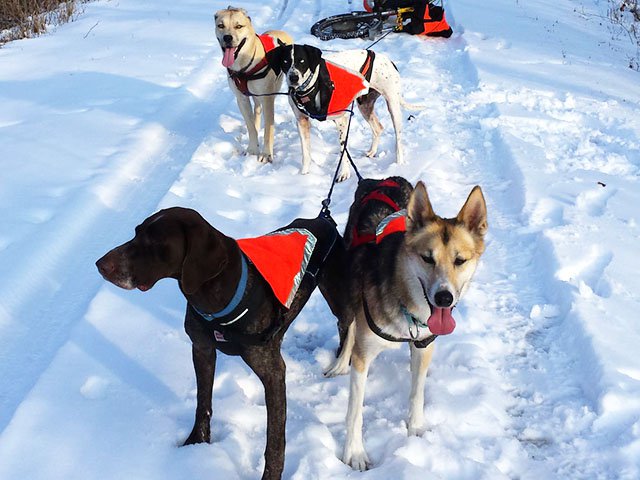
The dogs killed are in the foreground.  If these are the reflective vests in question, it is understandable how a hunter would not have seen them.  The dog on the right, the first one shot, would also have looked very much the coyote under low light conditions.

I find myself sympathetic with all parties involved.  What we have here is individuals called out by fate to be the symptoms of the need for change.

Some things need to change, and there is room for increased awareness and change on the part of all the interested parties.  Pet dog owners often treat wild areas as their own little parks and are then surprised and outraged when their dog is killed by a coyote, or in this more rare case, a hunter.

This actually an important point, the woman who lost her dogs was much more likely to loose them to coyote predation than to the hunter who mistook her domestic canines for wild ones.

Hunters have had the run of many of these areas since before the Second World War, and now need to accustom themselves to sharing them with pedestrians.  It is not irrational for us to expect the hunter to have seen the reflective vests.  The description of the event, which does not seem to be contested, reveals a hunter who did not properly identify his target.

You do not shoot at rustling bushes because it may be someone's child or grandfather.  That is ingrained into hunters from their first time in the field.  That needs to evolve into you do not shoot every canine that comes into range, it could be someone's husky.  This is even more important if you are hunting in populous Dane County, where hunters are more likely to interact with other recreational users of our public lands.

We could ban night hunting in some public lands and allow it in others, but be careful what you wish for.  Coyotes kill a lot more dogs than hunters and once they learn they are not being hunted, they will become ever so much bolder.

Regardless of the future, if you're going to take your dogs into wild places and let them off-lead, best learn how to reduce your chances of being a victim of coyote predation.


Sunday, March 20, 2016

Snapchat

I'm still trying to figure out Snapchat, but there does seem to be one use beyond teenagers sending revealing photographs to one another.

A friend who spends more time along the rivers of Minneapolis/St. Paul sent me this cool photograph of a coyote in the city.

At 42 I'm leaning into that age when I become harder to convince to try anything new.  I have my hands full with blogspot.  It does pay to have the app downloaded on a phone so that my younger, hipper, and more energetic friends can show me what they've seen.

Thursday, November 12, 2015

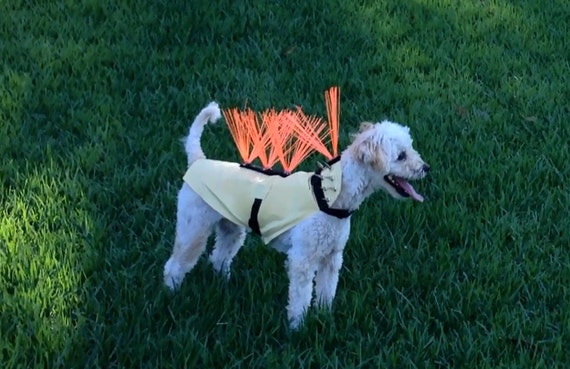
Coyote Zapper

Words fail me.

A Kevlar vest?  Yeah, maybe, I can understand.  I might buy one for tracking or hiking if the dog seemed to need it.  Probably not, but maybe in a bout of irrationality or in the midst of a week long bender.

Spiked collar?  Seems a bit of fashion overkill when there is still plenty of neck for a coyote to use to drag this dog off or it will just find its trachea ripped out from below but, hey, I roll in a libertarian direction, who am I to judge?

"Coyote whiskers"?  Alright, now you're going too far.  I am calling the animal welfare people.  No dog should be forced to wear that in public and definitely need to be taxed at a higher rate because you have too much disposable income.

"Coyote Zapper"?

The CoyoteZapper utilizes a dog training collar capable of delivering a painful shock. But instead of shocking your dog in the neck, it shocks the coyote in the mouth. 
It works by attaching two strips of highly conductive fabric along the length of the CoyoteVest and connecting them to the shock module. ​The strips are attached to either side of the CoyoteVest in such a way that it is impossible for a larger dog to pick up your small dog without his mouth touching both of them at the same time. If you push the button on the remote to activate the shock module the voltage will be directed though the strips directly into the mouth of the attacker. The shock is harmless, but painful enough to make the attacker let go.

I can't even remember where I put the poop bags half the time, like I'll always have the remote zapper control.

I love that the maker feels the need to assure us that the shock is harmless to the coyote.

Is there a hidden camera?  Is this, a skit from Portlandia?


Wednesday, August 26, 2015

Spare a coyote and...

My culture, that place where my assumptions meet my actions, has always included the readiness, at a second's notice, to destroy a coyote.


Since the crash which followed the "fur boom" I have only recently known anyone who actively hunted them.  You didn't so much as pursue them. They were more like the unexpected bonus that comes with spending time armed and in the field: always in season and always a possibility.

Now let me be honest, I have never killed one but not for lack of readiness. That I've only taken two shots at them in my life is due to the decades I spent living in cities. But they are the reason why, in my youth, men kept rifles behind the seat of their pickup truck, the reason I kept a broadhead I wasn't afraid to waste in my quiver. You always wanted to be ready to kill a coyote. When we first moved into the country, I was always ready to kill a coyote.


I received this behavior as a man-child from the men who raised me up and it was an expression of the times and assumptions of their ecological passions.   Coyotes will prey on young whitetail deer and the 1960's and 70's were a time when the whitetail deer were returning from the brink and restoring themselves to their natural range.  Coyotes did not appear to serve a purpose and hence to kill a coyote was to save a deer.

That reason to shoot coyotes on sight has outlived its usefulness.


In 2015 whitetail deer populations are more than recovered.  There are quite possibly more deer than is healthy for our natural areas or the long-term health of the species itself.  Coyote predation of young deer is minimal and whatever they do consume is a possible benefit to the population as a whole, not a cost. Some hunters are concerned at the amount of deer hair in coyote scat. Being twice as much the scavenger as the predator it is most likely that the hair came from a road kill or otherwise already dead or dying animal. It takes a lot of energy to take down a healthy deer, very little to kill a sick one, and no energy to eat something already dead. I know what the side of the road looks like around me and the math suggests coyotes are doing more cleaning up than killing.


Spare a coyote, kill a dozen cats, save a hundred birds, feed three foxes...
Secondly, numerous studies are reporting similar findings that the presence of coyotes reduces the feral cat population and restrains the predation of outdoor cats to the immediate vicinity around their homes. In other words, coyotes limit the damage done by outdoor cats.

Wisconsin hunters were right when they saw the threat of feral cats not only to wild bird species but to those native predators, fox, raptors, and owls, which compete with them for mice and voles.  
The feline fundamentalist successfully kept Wisconsin hunters from taking direction action on the threat but there is a backdoor approach open to Wisconsin hunters: promote healthy coyote numbers.

Of course my fur hunting friends should continue their pursuit of pelt and maybe when the winter coat is on, even I will take a shot and bringing home a 'yote, especially if the market value gets high enough. For most of us and the remainder of the year, however, the time has come to give that humble canine fill his own role in the ecosystem, the role of limiting damage done by an invasive species we continue to introduce and protect.