Showing posts with label wild places. Show all posts

Friday, May 6, 2016

Public Land: Legal Dueling over Dual Use

There was a time when hunters could assume that they had public land to themselves at night.

The expanding nature of dog culture, population increase, and new forms of outdoor recreation mean that is no longer the case.

Case and point, the mistaken killing of two dogs in Badfish Creek Wildlife Area,

Rausch was hunting at night on Jan. 22 in Badfish Creek Wildlife Area, land managed by the Department of Natural Resources, when he used a calling device to attract coyotes and heard animals respond. Rausch told a sheriff’s deputy that he “saw the eyes of what he believed to be a coyote and a face and pointy ears and pulled the trigger. Rausch stated that he did not realize it was a domesticated dog that he had shot.” Rausch also shot a second dog that ran up to him moments later.
The dogs belonged to Deanna Clark, a veterinarian, who was walking with her four dogs, all of whom were wearing reflective vests. Clark also wore a powerful headlamp. One dog died at the scene and the other days later. 
Tjader noted at her client’s preliminary hearing that Rausch had called 911 after the shootings and that he wrapped the surviving dog in his coat to carry it back to the parking lot.
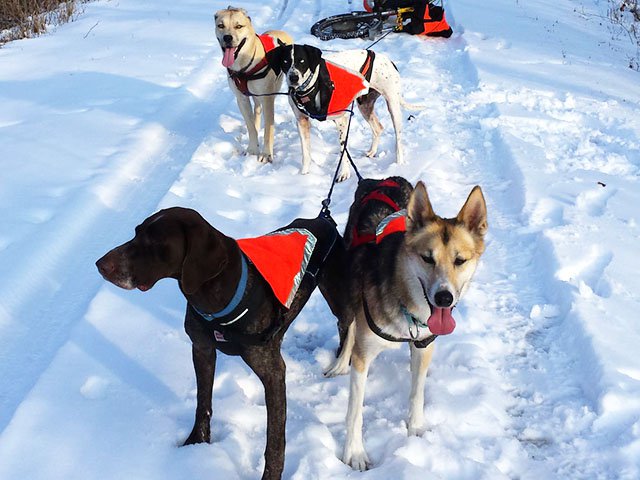
The dogs killed are in the foreground.  If these are the reflective vests in question, it is understandable how a hunter would not have seen them.  The dog on the right, the first one shot, would also have looked very much the coyote under low light conditions.

I find myself sympathetic with all parties involved.  What we have here is individuals called out by fate to be the symptoms of the need for change.

Some things need to change, and there is room for increased awareness and change on the part of all the interested parties.  Pet dog owners often treat wild areas as their own little parks and are then surprised and outraged when their dog is killed by a coyote, or in this more rare case, a hunter.

This actually an important point, the woman who lost her dogs was much more likely to loose them to coyote predation than to the hunter who mistook her domestic canines for wild ones.

Hunters have had the run of many of these areas since before the Second World War, and now need to accustom themselves to sharing them with pedestrians.  It is not irrational for us to expect the hunter to have seen the reflective vests.  The description of the event, which does not seem to be contested, reveals a hunter who did not properly identify his target.

You do not shoot at rustling bushes because it may be someone's child or grandfather.  That is ingrained into hunters from their first time in the field.  That needs to evolve into you do not shoot every canine that comes into range, it could be someone's husky.  This is even more important if you are hunting in populous Dane County, where hunters are more likely to interact with other recreational users of our public lands.

We could ban night hunting in some public lands and allow it in others, but be careful what you wish for.  Coyotes kill a lot more dogs than hunters and once they learn they are not being hunted, they will become ever so much bolder.

Regardless of the future, if you're going to take your dogs into wild places and let them off-lead, best learn how to reduce your chances of being a victim of coyote predation.


Thursday, August 27, 2015

Lead, Follow, or...

After trying and failing to find his owner we adopted a terrier that showed up on the front door late this summer.

He is a great little dog: socialized, friendly, and, important to me, with a wonderful, if under-developed, prey drive.

He was great in the house but what I saw suggested he hadn't been taken out into the world that much.  We've been working on rectifying that deficit in his education.  While we were taking a walk along the Red Cedar River, hilarity ensued.


Saturday, August 15, 2015

Wilderness Politics as Rorschach Test

Hard cases might make bad law but they can teach us to ask better questions.

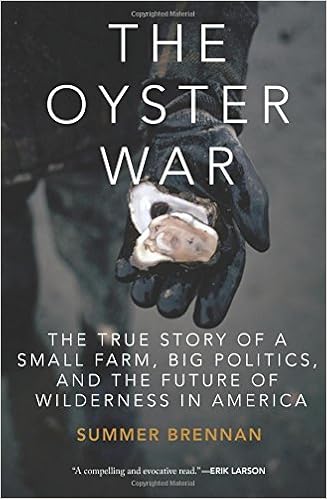
The Oyster War: The True Story of a Small Farm, Big Politics, and the Future of Wilderness in America by Summer Brennan tells the story of farming oysters (introduced from other parts of the world) in California and in doing so breaks open some of the important questions surrounding how we think about wild places.

Disclosure: I am still waiting to read the book.  I followed the story from a distance as it unfolded.  From what I have learned since, I never fully appreciated the passion involved closer to the action.

I highly recommend the podcast of an interview with the author found here or a review of the book here.

Romantic ideas about native and non-natives may have a place in small 
prairies and preserves, but Mediterranean grasses came to California with the first Spanish cattle, violets and bluebells grow alongside native flowers.  

Romantic ideas about returning areas to their pre-contact wildness are also questioned.  Native Americans managed the area in their own way, burning brush and managing prairie to support the local elk population.

Dairymen and cattle farmers were protected when the Point Reyes Wilderness Act became law, the lone oyster farm was not.  Life is sometimes like that.
However we define our ecological goals, they are bound to contain much that is arbitrary and artificial.  We are living in the Anthropocene and human beings are arbitrary.  As a product of evolution ourselves, though, I guess what we do is not technically "artificial" at least no more artificial than the transformation any other invasive species places on its environment.

Meh... I digress.

To the point, ecology is not something static across 
millennium but is always and has always been in flux.  If it has reached a new equilibrium, that should have some value.  If we want to alter the equilibrium or bend it in a new way, that can have value as well.

Let us be honest about this, we are making human decisions based upon human values and s
ometimes all we
are doing is pitting the value 
kayakers place upon an undisturbed ascetic against the value a farmer place upon local place or localvores place on low food-mile oysters.  The science suggests oysters did no harm to the ecology of the place but the idea of farmers in the wilderness ran counter to some perceptions of wilderness.

My reading of the story is that there was enough fault to go around.  Everybody was right.  Everybody was wrong. If you have too strong of an opinion on the matter, it is operating as a 
Rorschach test and telling me more about your internal life than the truth of the matter.


Eventually, however, a society just needs to make a decision.


As someone who is a little bit more concerned with eating than the appearance of an untamed-ness, my sympathies lie with the oyster farmers.  Legally, it appears as if the park service was well within its rights to end the lease of the oyster farmers, despite the fact that science could show no harm was being done.  

Tuesday, August 11, 2015

Practicing Prudence

Anytime someone dies, it is a tragedy.  Not so much for the dead person, they're dead and beyond comedy, tragedy, joy, or despair.

Prudence: Preparation, foresight, and judgment
For the people left behind, however, there is tragedy.

When people die in the wilderness, that tragedy is often brought on through the taking of risks.

Sometimes those risks are understood and considered acceptable.  More times than not, they arise from plain dumb luck, ignorance, or lack of discipline.

The hiker killed by a Yellowstone Grizzly, though there were no witnesses, would suggest an example of dumb luck.  The hiker had lived in Yellowstone multiple seasons and there are no indications that he had made any obvious mistake.

Living entails the possibility of dying.  Sometimes you get hit by the bus despite following all the safety regulations.  Sometimes you meet the grizzly with your number.

In hindsight one could say that he should have been carrying a .45 caliber handgun, but few hikers do and the decision is not an irrational one given the gun's weight, whether or not he feels the need to own one in his normal life, and the general safety of hiking in Yellowstone.

More times than not, however, wilderness deaths arise from ignorance or lack of discipline.

Consider a French couple, who heroically gave their lives to save their own son from the desert of the American southwest.  Unfortunately, it was they who put his life at risk in the first place, beginning their hike in the heat of the day and with less than 1/3 of the recommended amount of water.

Prepare twice, respect the wild, don't die.

Then there is just plain old lack of discipline or poor judgment.  The accident was avoidable.  The human involved knew better but the thing is looks like just too much fun and acts stupidly.

"Hey honey, hold my beer for a second..." or "It won't happen to me."

Prudence if you will, is comprised of all these things: preparation, foresight, and judgment.  It is a virtue, a character trait if you will, and it is learned.

I may be going out on a limb assuming the hillbillies who filmed this video knew better but it is only dumb luck that keeps them from returning to the Manitou.  I would suspect they exhibit imprudence in other areas of their lives.


Bear
That is the moment when you realize you messed up...
Posted by Ghetto fights & Crazy videos on Wednesday, July 16, 2014


If their families experience the tragedy of their loss, it was just as likely to happen in an urban center as in the wild, except maybe that the wild has fewer safety railings.  People raised in a world of safety railings are ill prepared to spend time unsupervised in the wild.