Showing posts with label eating. Show all posts

Wednesday, September 2, 2015

Old Fashioned Pickles

Making chunks
My people hate to see produce go to waste so when my mother called and asked if she should bring some over-sized cucumbers up on her next visit, the answer was an automatic, "of course."  I had no idea what I was going to do with them.

A few years ago we started lacto-fermenting vegetables.  We never went into it in a big way, it was just something I did now and again.  Frankly, I ended up eating most of them and what I didn't eat went to the chickens.

Still we were involved enough that I bought a crock just for the process, and then we ended up not using it.  It has sat stored in our closet for years, until now.

The cucumbers were large, the kids have been gorging themselves on pickles recently, so I decided to make pickle chunks with them.
Keep in mind that I like my pickles with a little bit of a kick, the recipe was drawn from the book Wild Fermentation and went something like this:

Into bottom of crock place:
  • a dozen peppercorns
  • two pinches dried dill
  • one palm of dried chili peppers
  • a few shakes of garlic powder (to my shame we were out of garlic)
  • a dozen green oak leaves (any source of tannin  would work to help keep the pickles crisp)


Pickles and brine drained from the crock
 Then I added enough chunked cucumbers to fill the crock and a salt water brine (3T salt for every gallon of water) to cover.
Prepare to be canned

Then I let it sit in the cool garage for about a week.  Most advice calls for the crock to be checked daily and the removal of any mold.  I was mold free until the last day when I brought the pickles into the house.

We ended up with more than seven quarts of sour pickles.  They were a little salty for my taste but they could be rinsed before serving.  We also decided to try canning what would not be consumed in just a couple of days.

I am sure they would have stored fine in the fridge but I wanted to see how they taste after the canning process.  I would like to do more of this in the future, if it looks like I can store the harvest well into the next year.

Each jar of pickles received one oak leaf and was half-filled with brine and tap water to the shoulder before canning.

About two weeks after canning the pickles I opened up a can.  They had lost some of that fresh crispness in the middle of each chuck but along the cucumber rind they retained a nice snappy crunch.

A wonderful experiment we'll look forward to expanding upon next year.


Thursday, August 20, 2015

Improv as Virtue

I had planned on taking the kids to the movies.

It was humid, hot and getting hotter and the Shaun the Sheep movie had been out a week.  I'd talked the oldest into avoiding the Fantastic Four movie in favor of Ant Man.  The air conditioning would be nice.

The kids had worked well the week before and there was just one chore left to do before showering and lunch.

When it is time to move sheep from one paddock to another, the oldest, the sheep, and I have developed a rhythm.  Even managing two new ewes, the job was little more than a hassle, but one ram lamb, "Hurricane," refused to dance to the tune we were calling.  From where I stood, I could see he had a nasty limp.

Otto penned him up while we closed gates and counted heads but the bad news was waiting for me when I got there: his right rear foot was flopping as he hobbled.

The break was fresh.  The lamb voiced no distress and there was no infection yet but it was obvious and severe.  He had to be in pain.  Infection would be coming.  There would be no recovery.

He had been destined for the butcher's block in another two months anyway, but we had plans; but I had not mentally prepared myself to do *that* job on this day.

We were, in the end fortunate.  I did not have to lecture the children about the virtue of improv: my mother was up visiting and was happy to take them to the movies.  They all got some ice cream to boot.

Me, I had a beer for lunch and went to work.


Saturday, August 15, 2015

Wilderness Politics as Rorschach Test

Hard cases might make bad law but they can teach us to ask better questions.

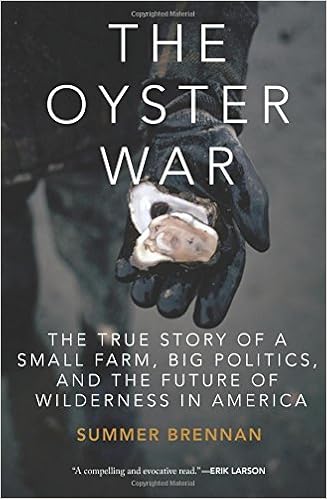
The Oyster War: The True Story of a Small Farm, Big Politics, and the Future of Wilderness in America by Summer Brennan tells the story of farming oysters (introduced from other parts of the world) in California and in doing so breaks open some of the important questions surrounding how we think about wild places.

Disclosure: I am still waiting to read the book.  I followed the story from a distance as it unfolded.  From what I have learned since, I never fully appreciated the passion involved closer to the action.

I highly recommend the podcast of an interview with the author found here or a review of the book here.

Romantic ideas about native and non-natives may have a place in small 
prairies and preserves, but Mediterranean grasses came to California with the first Spanish cattle, violets and bluebells grow alongside native flowers.  

Romantic ideas about returning areas to their pre-contact wildness are also questioned.  Native Americans managed the area in their own way, burning brush and managing prairie to support the local elk population.

Dairymen and cattle farmers were protected when the Point Reyes Wilderness Act became law, the lone oyster farm was not.  Life is sometimes like that.
However we define our ecological goals, they are bound to contain much that is arbitrary and artificial.  We are living in the Anthropocene and human beings are arbitrary.  As a product of evolution ourselves, though, I guess what we do is not technically "artificial" at least no more artificial than the transformation any other invasive species places on its environment.

Meh... I digress.

To the point, ecology is not something static across 
millennium but is always and has always been in flux.  If it has reached a new equilibrium, that should have some value.  If we want to alter the equilibrium or bend it in a new way, that can have value as well.

Let us be honest about this, we are making human decisions based upon human values and s
ometimes all we
are doing is pitting the value 
kayakers place upon an undisturbed ascetic against the value a farmer place upon local place or localvores place on low food-mile oysters.  The science suggests oysters did no harm to the ecology of the place but the idea of farmers in the wilderness ran counter to some perceptions of wilderness.

My reading of the story is that there was enough fault to go around.  Everybody was right.  Everybody was wrong. If you have too strong of an opinion on the matter, it is operating as a 
Rorschach test and telling me more about your internal life than the truth of the matter.


Eventually, however, a society just needs to make a decision.


As someone who is a little bit more concerned with eating than the appearance of an untamed-ness, my sympathies lie with the oyster farmers.  Legally, it appears as if the park service was well within its rights to end the lease of the oyster farmers, despite the fact that science could show no harm was being done.  

Wednesday, August 12, 2015

Some Friends actually are Food

Anthropology and psychology, like the other social sciences, can not help but be constrained by the culture and experiences of the observers.

By studying others we hope to learn about what it means to be human.  As often than not, however, what we end up doing is revealing our own provincialism.  In this recent article reviewing a study of cat consumption in certain of Madagascar, the provisionalism of this modern American life shines forth.


The researchers had hypothesized that because cat meat was not a preferred food, its consumption would be restricted to economic hard times. They were wrong. There was no evidence that people turned to eating cat only as a last resort when other forms of meat were unavailable. Rather, killing and eating cats seemed to be motivated more by sheer opportunity than necessity or a pronounced culinary preference. 
The researchers also wanted test the notion that food taboos are culturally transmitted. Thus they predicted that the towns would differ in the strength of prohibitions against eating feline flesh. This was technically true: for example, 10% of the residents in one town had a personal taboo against eating cat compared to none of the inhabitants of another town. On the whole, however, only 3% of all the individuals interviewed in the study were disgusted by the idea of eating cat meat. As the consumption of dog meat is widely tabooed on the island of Madagascar, the lack of prohibitions against eating cats is surprising.

It was once the case that the nation's cities were populated by the excess population of the countryside.  Farm mechanization created the extra labor which helped build our cities and populated the Chair's of academic departments from Veterinary Science to Shakespeare.  

Increasingly, however, those positions are filled by women and men whose closest connection to
2015: Some friends are food.

agricultural production is ever more likely to have been a grandparent or great-grandparent to whom they can not relate.  Consequently, they are spending research dollars on questions any farm kid of reasonable insight could answer.

What farm kids understand is that human relationships to the animals surround us do not fit into an easy trichotomy of the majestic wild, anonymous meat wrapped in cellophane, and pampered fur baby of a cat or dog but rather exist upon a spectrum from pest to companion. We care for our livestock and can be saddened at sending a favorite animal to market. 

Members of a single species of wild animal can be pest, food, a majestic animal to watch from the porch, depending upon the context.   Pets can be working members of the farm and contributers to the hunt who experience the real risk of harm in the process.  

They are not babies, they are members of a tribe or family, and membership comes with responsibilities as well as rights.

When I was seven it was time to butcher the goat that I had treated as a pet.  My mother was worried
1978: "Is it ready for the freezer yet?"


that I might be traumatized so a slightly older cousin was tasked to keep me away from the carcass until it looked a little less like my pet.  The cousin but my mother realized her concern was unfounded when i asked, "So, does it go in the freezer like this?"   At a young age I understood why we had cared for the goat. I understood sacrifice for the good of the pack. I understood that we had claims on the goat as well as an obligation to care for it. Over at the Huffington Post, these are foreign concepts.
To me, the biggest surprise of the research was related to how Madagascarans obtained their cat meat. Half of the time they simply ate the family pet. Cat meat was also commonly acquired in the form of gifts from friends. And sometimes cats were caught by hand or by trapping. In one of the towns, most of the cats were - gulp -- road kill. Hardly anyone had ever bought cat meat at a market.
They didn't buy their meat at the local Whole Foods! The inhumanity!


In hunting or farming, the writers over at Downton Abbey put the idea succinctly into the mouth of Lady Edith, “there is room for sentiment" in our relationship with animals "but not for sentimentality.”

If they had experience life with livestock, these anthropologists would be able to easily understand a culture where farm animals can be both objects of affection AND sources of protein. The culture of the Madagascar villagers is not the anomaly, but rather a culture where animals are either treated as unfeeling machines of production or surrogate children based merely upon their cultural-specific purpose.   When you live with living things, you learn to treat them all as living things. Where protein can not be taken for granted it is not left to rot along the side of the road.

I ate some roadkill last week. Is it more respectful to leave an animal to rot along side the road or consume it?

Color me cynical but I believe if we took away Frontline and the rabies vaccine and our own culture would very quickly shed the "fur baby" facade for a more practical approach to our cats and dogs. If I were worried about my children's nutrition, I'd be more than happy to expand the species of which I am willing to process roadkill into meat. I mean crock pot cat can't be much worse than baked opossum.