Showing posts with label ecosystem. Show all posts

Wednesday, October 7, 2015

Perspective

Referring to the current epoch of geological time as the Anthropocene may be a mere act of hubris.  If a comet of adequate size and velocity slams into Paris tomorrow or any time within the next 100,000 years, any future intelligent life on this planet won't recognize it as anything but prelude to what followed.

http://www.economist.com/node/18741749


Apart from interjecting god into the discussion, there is no reason for us to even prefer the current ecological arrangement of the planet. I mean we care because we have done quite well under the current arrangement and are therefore invested in its continuance.  The universe, however, doesn't care.  The earth neither weeps nor rejoices in us.  Philosophically it matters not if the current epoch continues to declines.

Only we care about the outcome of the Anthropocene because, you see, we are the Anthrops.  Ecological concerns come to the forefront of our mind because we live in them, eat from them, and die in them.

I find the concept of the Anthropocene intriguing because it means we finally get a chance to see how sentient human beings really are. While I do not believe we know as much about the world as we claim, we know enough to start making decisions based upon impacts beyond the current lifetime.

Our perspective is better than it has ever been, but will we care?

We have the power to change the globe for good or for ill, will our tribal nature limit our vision?

 Are we, as a species, truly capable of choice, or are we just a bunch of reindeer stripping resources until we starve?

I don't know.  Until recently, however, it would be hard to imagine asking these questions.  It isn't that we lacked agency.  We just lacked the perspective to perceive the impact of our agency. Will perception make a difference?



Thursday, September 24, 2015

Wolf Management Requires Hunting

Wolves are an important part of our ecosystem.  
Wolves exist in the ecosystem due to goodwill of the people who live in the same area.

Therefore, maintaining human goodwill toward wolves is good for the ecosystem.

This simple syllogism demonstrates what the "no hunting wolves anywhere" fail to understand.  I doubt even the most extreme police state technologically possible can protect the wolves from human depredation if the humans who live near them resent their presence.

"Dual use technology" is not just about outlaw states seeking chemical or nuclear weapons.

The wolf/human relationship needs to be managed.  We've seen what happens when that relationship is allowed to follow their natural course: wolves go extinct.

With that I am hopeful that granting Adrian Wydeven a podium at the debate will lead to the rationalization of the debate about Wisconsin's wolves that will allow long term management that is good for the wolves, good for people, and good for the ecosystem.


Saturday, August 15, 2015

Wilderness Politics as Rorschach Test

Hard cases might make bad law but they can teach us to ask better questions.

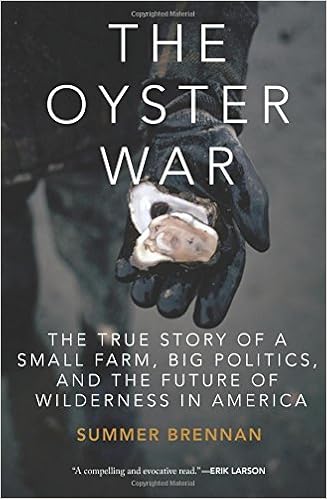
The Oyster War: The True Story of a Small Farm, Big Politics, and the Future of Wilderness in America by Summer Brennan tells the story of farming oysters (introduced from other parts of the world) in California and in doing so breaks open some of the important questions surrounding how we think about wild places.

Disclosure: I am still waiting to read the book.  I followed the story from a distance as it unfolded.  From what I have learned since, I never fully appreciated the passion involved closer to the action.

I highly recommend the podcast of an interview with the author found here or a review of the book here.

Romantic ideas about native and non-natives may have a place in small 
prairies and preserves, but Mediterranean grasses came to California with the first Spanish cattle, violets and bluebells grow alongside native flowers.  

Romantic ideas about returning areas to their pre-contact wildness are also questioned.  Native Americans managed the area in their own way, burning brush and managing prairie to support the local elk population.

Dairymen and cattle farmers were protected when the Point Reyes Wilderness Act became law, the lone oyster farm was not.  Life is sometimes like that.
However we define our ecological goals, they are bound to contain much that is arbitrary and artificial.  We are living in the Anthropocene and human beings are arbitrary.  As a product of evolution ourselves, though, I guess what we do is not technically "artificial" at least no more artificial than the transformation any other invasive species places on its environment.

Meh... I digress.

To the point, ecology is not something static across 
millennium but is always and has always been in flux.  If it has reached a new equilibrium, that should have some value.  If we want to alter the equilibrium or bend it in a new way, that can have value as well.

Let us be honest about this, we are making human decisions based upon human values and s
ometimes all we
are doing is pitting the value 
kayakers place upon an undisturbed ascetic against the value a farmer place upon local place or localvores place on low food-mile oysters.  The science suggests oysters did no harm to the ecology of the place but the idea of farmers in the wilderness ran counter to some perceptions of wilderness.

My reading of the story is that there was enough fault to go around.  Everybody was right.  Everybody was wrong. If you have too strong of an opinion on the matter, it is operating as a 
Rorschach test and telling me more about your internal life than the truth of the matter.


Eventually, however, a society just needs to make a decision.


As someone who is a little bit more concerned with eating than the appearance of an untamed-ness, my sympathies lie with the oyster farmers.  Legally, it appears as if the park service was well within its rights to end the lease of the oyster farmers, despite the fact that science could show no harm was being done.