Showing posts with label farming. Show all posts

Sunday, February 14, 2016

Hay delivery

The last few years we have fed large round bales through the winter.

They are delivered before the first snow and a neighbor moves them all up hill.  I roll them down hill as we have need.  Either my calculations were bad this last fall or the sheep have wasted more hay than normal.  Of course if anyone is to blame for not taking into account wastage, it is me.

Sheep are not interested in thrift.

There is way too much ice to have large bales of hay moved around, so it is time to resort to the time tested method of feeding small bales.  In the loft of our small barn we can fit 50-80 bales depending upon their size.  More can be fit in the storage side of the barn.

A 120 bales delivered with two of my three helpers ready to go.
Thanks to them I only had to carry 116 bales up the hill to the barn

The third helper was in the loft doing the stacking.  


It was cold enough, I don't even care that this guy could reach through to steal some nibbles.
118 bales later.

The Icelandic Sheep approve of the new hay.
When I came in this man-pup was doing push-ups.  I guess I need to find some harder jobs.


Thursday, October 1, 2015

Evangelicals Leaders Move against Factory Farms

It has been coming in fits and starts and now the fight is joined.

Today a group of prominent evangelicals issued a statement and a call to action.

"Animals have value to God independent from human use."

Those last four words make all the theological difference in the world.

From Kristen Powers over at USA Today.

The proclamation, which provides extensive scriptural citation, asserts, “God has given all animals the breath of life, that He sustains them… they belong ultimately to Him, and… He has declared them ‘good,’ indicating they have value to Him independent of human use.” 
Many conservative evangelicals bristle at the mention of the animal rights movement because they believe it puts humans and animals on equal footing. But the evangelical statement is unequivocal that humans hold a unique status in creation. In fact, it’s this special status that demands humans practice extra care with all of God’s creation. The signatories affirmed the belief that, “all animals ultimately belong to God, are sustained by Him, and exist to bring Him praise and reveal His character.” 
Also being announced today is the launch of the “Every Living Thing” initiative, which will begin a year-long effort to engage Christians in dialogue around the biblical mandate to care for animals.

Muslim, Christian, Jew, Humanist: change people's theology and you change how they live.

Of course the movement will not be without push back but it will start a conversation, most importantly in the minds of farmers who count themselves among the faithful.  Suzy Suburban can read the news and go about her life without thinking about the cellophane wrapped pork chops she's cooking for dinner.  The hog farmer lives with his hogs everyday.  The dairyman knows his cows health better than his own.

The Humane Society is publishing a book of Christian writings on the subject.
You can check out the website.
Their doing The Facebook.
Of course there is a video.


For ordinary people the movement toward humane treatment of all animals starts with the family dog or cat.  The move toward more humane treatment of farm animals will reach its zenith with the professional livestock-man and in America your average livestock-man is an Evangelical Christian.


Thursday, August 20, 2015

Improv as Virtue

I had planned on taking the kids to the movies.

It was humid, hot and getting hotter and the Shaun the Sheep movie had been out a week.  I'd talked the oldest into avoiding the Fantastic Four movie in favor of Ant Man.  The air conditioning would be nice.

The kids had worked well the week before and there was just one chore left to do before showering and lunch.

When it is time to move sheep from one paddock to another, the oldest, the sheep, and I have developed a rhythm.  Even managing two new ewes, the job was little more than a hassle, but one ram lamb, "Hurricane," refused to dance to the tune we were calling.  From where I stood, I could see he had a nasty limp.

Otto penned him up while we closed gates and counted heads but the bad news was waiting for me when I got there: his right rear foot was flopping as he hobbled.

The break was fresh.  The lamb voiced no distress and there was no infection yet but it was obvious and severe.  He had to be in pain.  Infection would be coming.  There would be no recovery.

He had been destined for the butcher's block in another two months anyway, but we had plans; but I had not mentally prepared myself to do *that* job on this day.

We were, in the end fortunate.  I did not have to lecture the children about the virtue of improv: my mother was up visiting and was happy to take them to the movies.  They all got some ice cream to boot.

Me, I had a beer for lunch and went to work.


Saturday, August 15, 2015

Wilderness Politics as Rorschach Test

Hard cases might make bad law but they can teach us to ask better questions.

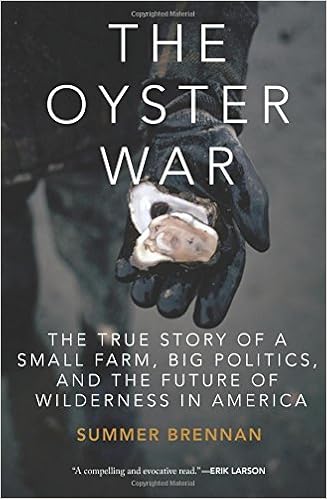
The Oyster War: The True Story of a Small Farm, Big Politics, and the Future of Wilderness in America by Summer Brennan tells the story of farming oysters (introduced from other parts of the world) in California and in doing so breaks open some of the important questions surrounding how we think about wild places.

Disclosure: I am still waiting to read the book.  I followed the story from a distance as it unfolded.  From what I have learned since, I never fully appreciated the passion involved closer to the action.

I highly recommend the podcast of an interview with the author found here or a review of the book here.

Romantic ideas about native and non-natives may have a place in small 
prairies and preserves, but Mediterranean grasses came to California with the first Spanish cattle, violets and bluebells grow alongside native flowers.  

Romantic ideas about returning areas to their pre-contact wildness are also questioned.  Native Americans managed the area in their own way, burning brush and managing prairie to support the local elk population.

Dairymen and cattle farmers were protected when the Point Reyes Wilderness Act became law, the lone oyster farm was not.  Life is sometimes like that.
However we define our ecological goals, they are bound to contain much that is arbitrary and artificial.  We are living in the Anthropocene and human beings are arbitrary.  As a product of evolution ourselves, though, I guess what we do is not technically "artificial" at least no more artificial than the transformation any other invasive species places on its environment.

Meh... I digress.

To the point, ecology is not something static across 
millennium but is always and has always been in flux.  If it has reached a new equilibrium, that should have some value.  If we want to alter the equilibrium or bend it in a new way, that can have value as well.

Let us be honest about this, we are making human decisions based upon human values and s
ometimes all we
are doing is pitting the value 
kayakers place upon an undisturbed ascetic against the value a farmer place upon local place or localvores place on low food-mile oysters.  The science suggests oysters did no harm to the ecology of the place but the idea of farmers in the wilderness ran counter to some perceptions of wilderness.

My reading of the story is that there was enough fault to go around.  Everybody was right.  Everybody was wrong. If you have too strong of an opinion on the matter, it is operating as a 
Rorschach test and telling me more about your internal life than the truth of the matter.


Eventually, however, a society just needs to make a decision.


As someone who is a little bit more concerned with eating than the appearance of an untamed-ness, my sympathies lie with the oyster farmers.  Legally, it appears as if the park service was well within its rights to end the lease of the oyster farmers, despite the fact that science could show no harm was being done.