Thursday, August 13, 2015

Diana's Day


The days are still warm but I can't help but notice they are getting shorter and I am starting to get an itch for hunting season.  

There must be something deep in the genome about this time of year.  Long before the DNR or even the concept of conservation fall was a time to remember the hunt and its goddess: Diana.

I live in a diverse household.  I am an atheist.  My wife follows an Anabaptist style of Christianity.  The dogs are into Zen and the cat is a straight up Nihilst.

None of us are pagans in any meaningful sense of the word.

I, however, like the vast majority of other human beings can appreciate a good rhythm to the seasons of the year and think it is meaningful, or at least enjoyable, to commemorate them.  So despite the furrowed brow of my wife, the dogs and I do a little something to mark the approach of the absolute best time of the year.

For the sake of household harmony there are no sacrifices or candles lit before idols and only the canines are allowed to dance naked before consuming some roadkill deer hoof that has been parked in the freezer.  

We clean out the hunting gear, oil up any firearms that need it, repack the plastic tote which carries all the tracking and hunting supplies I might need for the dogs.  I will set out my deer hunting clothes so the scent can naturalize before the September opener.

I have often thought of going vegetarian for the month between Diana's Day and the opening of the deer bow season.  I recall some old timers telling me once how this was their tradition believing that carnivorous humans and herbivorous humans smell differently to approaching deer.  Color me skeptical, either way, you smell like a human.  Still, the discipline would be welcome and it would add to the suspense of the approaching opener.

Still, I wish I were enough of a romantic to be able to wax lyrical about Diana, chaste and fair but really, I just want to go huntin'.


Wednesday, August 12, 2015

Some Friends actually are Food

Anthropology and psychology, like the other social sciences, can not help but be constrained by the culture and experiences of the observers.

By studying others we hope to learn about what it means to be human.  As often than not, however, what we end up doing is revealing our own provincialism.  In this recent article reviewing a study of cat consumption in certain of Madagascar, the provisionalism of this modern American life shines forth.


The researchers had hypothesized that because cat meat was not a preferred food, its consumption would be restricted to economic hard times. They were wrong. There was no evidence that people turned to eating cat only as a last resort when other forms of meat were unavailable. Rather, killing and eating cats seemed to be motivated more by sheer opportunity than necessity or a pronounced culinary preference. 
The researchers also wanted test the notion that food taboos are culturally transmitted. Thus they predicted that the towns would differ in the strength of prohibitions against eating feline flesh. This was technically true: for example, 10% of the residents in one town had a personal taboo against eating cat compared to none of the inhabitants of another town. On the whole, however, only 3% of all the individuals interviewed in the study were disgusted by the idea of eating cat meat. As the consumption of dog meat is widely tabooed on the island of Madagascar, the lack of prohibitions against eating cats is surprising.

It was once the case that the nation's cities were populated by the excess population of the countryside.  Farm mechanization created the extra labor which helped build our cities and populated the Chair's of academic departments from Veterinary Science to Shakespeare.  

Increasingly, however, those positions are filled by women and men whose closest connection to
2015: Some friends are food.

agricultural production is ever more likely to have been a grandparent or great-grandparent to whom they can not relate.  Consequently, they are spending research dollars on questions any farm kid of reasonable insight could answer.

What farm kids understand is that human relationships to the animals surround us do not fit into an easy trichotomy of the majestic wild, anonymous meat wrapped in cellophane, and pampered fur baby of a cat or dog but rather exist upon a spectrum from pest to companion. We care for our livestock and can be saddened at sending a favorite animal to market. 

Members of a single species of wild animal can be pest, food, a majestic animal to watch from the porch, depending upon the context.   Pets can be working members of the farm and contributers to the hunt who experience the real risk of harm in the process.  

They are not babies, they are members of a tribe or family, and membership comes with responsibilities as well as rights.

When I was seven it was time to butcher the goat that I had treated as a pet.  My mother was worried
1978: "Is it ready for the freezer yet?"


that I might be traumatized so a slightly older cousin was tasked to keep me away from the carcass until it looked a little less like my pet.  The cousin but my mother realized her concern was unfounded when i asked, "So, does it go in the freezer like this?"   At a young age I understood why we had cared for the goat. I understood sacrifice for the good of the pack. I understood that we had claims on the goat as well as an obligation to care for it. Over at the Huffington Post, these are foreign concepts.
To me, the biggest surprise of the research was related to how Madagascarans obtained their cat meat. Half of the time they simply ate the family pet. Cat meat was also commonly acquired in the form of gifts from friends. And sometimes cats were caught by hand or by trapping. In one of the towns, most of the cats were - gulp -- road kill. Hardly anyone had ever bought cat meat at a market.
They didn't buy their meat at the local Whole Foods! The inhumanity!


In hunting or farming, the writers over at Downton Abbey put the idea succinctly into the mouth of Lady Edith, “there is room for sentiment" in our relationship with animals "but not for sentimentality.”

If they had experience life with livestock, these anthropologists would be able to easily understand a culture where farm animals can be both objects of affection AND sources of protein. The culture of the Madagascar villagers is not the anomaly, but rather a culture where animals are either treated as unfeeling machines of production or surrogate children based merely upon their cultural-specific purpose.   When you live with living things, you learn to treat them all as living things. Where protein can not be taken for granted it is not left to rot along the side of the road.

I ate some roadkill last week. Is it more respectful to leave an animal to rot along side the road or consume it?

Color me cynical but I believe if we took away Frontline and the rabies vaccine and our own culture would very quickly shed the "fur baby" facade for a more practical approach to our cats and dogs. If I were worried about my children's nutrition, I'd be more than happy to expand the species of which I am willing to process roadkill into meat. I mean crock pot cat can't be much worse than baked opossum.

Tuesday, August 11, 2015

Practicing Prudence

Anytime someone dies, it is a tragedy.  Not so much for the dead person, they're dead and beyond comedy, tragedy, joy, or despair.

Prudence: Preparation, foresight, and judgment
For the people left behind, however, there is tragedy.

When people die in the wilderness, that tragedy is often brought on through the taking of risks.

Sometimes those risks are understood and considered acceptable.  More times than not, they arise from plain dumb luck, ignorance, or lack of discipline.

The hiker killed by a Yellowstone Grizzly, though there were no witnesses, would suggest an example of dumb luck.  The hiker had lived in Yellowstone multiple seasons and there are no indications that he had made any obvious mistake.

Living entails the possibility of dying.  Sometimes you get hit by the bus despite following all the safety regulations.  Sometimes you meet the grizzly with your number.

In hindsight one could say that he should have been carrying a .45 caliber handgun, but few hikers do and the decision is not an irrational one given the gun's weight, whether or not he feels the need to own one in his normal life, and the general safety of hiking in Yellowstone.

More times than not, however, wilderness deaths arise from ignorance or lack of discipline.

Consider a French couple, who heroically gave their lives to save their own son from the desert of the American southwest.  Unfortunately, it was they who put his life at risk in the first place, beginning their hike in the heat of the day and with less than 1/3 of the recommended amount of water.

Prepare twice, respect the wild, don't die.

Then there is just plain old lack of discipline or poor judgment.  The accident was avoidable.  The human involved knew better but the thing is looks like just too much fun and acts stupidly.

"Hey honey, hold my beer for a second..." or "It won't happen to me."

Prudence if you will, is comprised of all these things: preparation, foresight, and judgment.  It is a virtue, a character trait if you will, and it is learned.

I may be going out on a limb assuming the hillbillies who filmed this video knew better but it is only dumb luck that keeps them from returning to the Manitou.  I would suspect they exhibit imprudence in other areas of their lives.


Bear
That is the moment when you realize you messed up...
Posted by Ghetto fights & Crazy videos on Wednesday, July 16, 2014


If their families experience the tragedy of their loss, it was just as likely to happen in an urban center as in the wild, except maybe that the wild has fewer safety railings.  People raised in a world of safety railings are ill prepared to spend time unsupervised in the wild.
 

Me-Child Joy

Kill
deer.
Killdeer,
prarie friend,
coaxing me forward
with her old, "Look, I'm injured!" trick:

forty-one and still feeling the joy of the me-child.

Monday, August 10, 2015

In what does happiness consist?

And for that, I shall tell you, that in ancient times a debate hath risen, and it remains yet unresolved, whether the happiness of man in this world doth consist more in contemplation or action? Concerning which, some have endeavoured to maintain their opinion of the first; by saying, that the nearer we mortals come to God by way of imitation, the more happy we are. And they say, that God enjoys himself only, by a contemplation of his own infiniteness, eternity, power, and goodness, and the like. And upon this ground, many cloisteral men of great learning and devotion, prefer contemplation before action...

And on the contrary, there want not men of equal authority and credit, that prefer action to be the more excellent; as namely, experiments in physick, and the application of it, both for the ease and prolongation of man's life; by which each man is enabled to act and do good to others, either to serve his country, or do good to particular persons: and they say also, that action is doctrinal, and teaches both art and virtue, and is a maintainer of human society; and for these, and other like reasons, to be preferred before contemplation.

Concerning which two opinions I shall forbear to add a third, by declaring my own; and rest myself contented in telling you, my very worthy friend, that both these meet together, and do most properly belong to the most honest, ingenuous, quiet, and harmless art of angling.

I wrote a post today, and I was unhappy with it, because it was not good.  It was the worst mix of banal and preachy.  It was unreflective, and the ills it identified I proposed no concrete solution for.  It had form and no substance.  It was all rhetoric, and it was not in the spirit of the angler, that being the most peaceable spirit of humanity.

I am now sitting on my porch, writing this article, and I am unhappy with it. Even while it sits incomplete.  I am unhappy because I am not fishing.

Angling provides an outlet for me. It is both action and reflection, motion and pause, seeking without the desire to take.

Every fishing excursion begins with ritual.  I decide on the location or quarry, and I load the car.  I pack what I need, and I hope nothing more.  I drive, park the car, and walk to my location.  I unburden myself of gear, rig my rod, bait my hook, and cast.

Then I sit.  I sit and I imagine.  I imagine what is happening in the water.  Where is the current pushing food?  Where are the baitfish congregating?  What are the larger fish hunting?  What are they avoiding?  Where is the wind blowing?  What are the larger fish avoiding?  Perhaps the current is too strong here, the depth wrong there, the sun to bright there.  What does the fish desire, what does it abhor?  I recast, or I don't.

Then my mind drifts.  To the birds, the sound of people in the distance, the thought of fish uncaught, untempted by bait.  To my family, to old friends, to the vagaries of my day, to the words said and unsaid.

And then I am lost in contemplation.  Stone still.  Unevaluating, only thinking.  I have neither want nor worry.  There is only this moment, these data, this feeling.  In the world swirling with motion, I am unmoving.

There is an ineffable calm in this.  The ritual provides the circumstance for reprieve, calculated movements that provide the opportunity for serenity. In a world too full of people, I am alone.

Even in excursions which involve others, this experience is felt.  All present are forced to focus on the tightness of the lines, the vibration of the current.  There is only the moment at hand.  The light reflects upon the water.  The wind fractures the light.  The cool breeze brushes our faces, and the beer quenches the moments of thirst, completing the sensory experience.

This is the zenith of fishing for me.  The nadir of self-invested consciousness. If a fish pulls my line, I am ready for it.  If it takes the bait of another, I am equally prepared, and equally elated.  There is both self and an absence of selfhood.  We are fishing, and I am fishing. Nothing else registers.

And when a fish bites, there is a fight.  The fish pulls, we pull back.  Give and take.  The fish surfaces, is netted reluctantly, and we admire it.  We share this moment with the fish, and then return it to its water.

This is the difference between meditation and contemplation. Meditation has no end, no goal, no object.  Contemplation requires an object. Upon that Object all other things hinge.  Both objects and subjects hinge on this Object, and are thought of in reference to It.  The world for some finite time has an Archedmedian point by which to move the universe.  We are all centered upon it.  Angling is contemplative at its very core.

Angling provides for me the opportunity to imagine an objective reference to everything else in my life.  And once achieved, it is released. Sent back to its own world and constellations, free to navigate its own way home.

Angling is honest.  You cannot cheat your way into fish.  They bite or they do not.  There is no bribing a fish except by honest offering of bait or artifice.

Angling is ingenious.  There is nothing except earnest labor and hard earned skill that can convince a fish to bite.

Angling is quiet.  To imagine the world outward, the angler must force himself to focus inward.  The angler is absorbed in thought, tied by one tiny string to the world outside him, and all his will must be channeled through it.

And angling is, at its best, harmless.  I have never met an angler dedicated to his craft that does not love the fish he seeks, always hoping to impose the minimum harm upon it.  I have never met an angler dedicated to his craft that does not see some camaraderie with fellow fishermen, or fail to cultivate the greatest affection and affinity among them.

Happiness is a cool breeze, a bend in the rod, and the company of those who share one's simple pleasure.

Please accept this as a testimony of the honest, ingenious, quiet, and harmless art of angling.

Sunday, August 9, 2015

With great power

With great power comes unintended consequences.

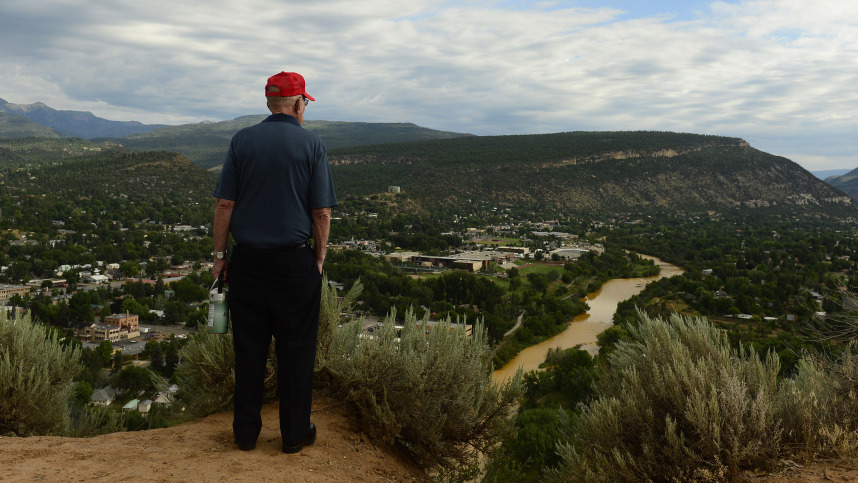
An environmental cleanup of an abandoned mine in the mountains of Colorado went horribly wrong, leading to the spill of one million gallons of contaminated water into a creek that eventually drains into the San Juan River. 
The incident happened when workers for the Environmental Protection Agency were trying to clean the long-abandoned Gold King Mine, but allowed it to breach a berm, or small strip of raised land, and the toxic water flowed into the Animas River. It turned the clear mountain stream a mustard orange color, according to photos posted online. The local sheriff’s office on Aug. 6 closed the river to swimming, kayaking and rafting, and it remained closed Saturday. 
“It’s a sad irony that a program attempting to avoid harm to the environment, appears to have caused it,” said Taylor McKinnon, public lands coordinator for the Center for Biological Diversity, a nonprofit group in Colorado. As the polluted waste moves downstream, “it will dilute, but we don’t know what’s in this water,” McKinnon said. 
According to a statement posted online by the San Juan Basin Health Department, the acidic mine water contains high levels of sediment and metals. Officials warned downstream users to shut off intake valves.


Friday, August 7, 2015

Terriers dig Hydrology

The need for a paycheck means we can't hunt everyday, but we can still get an outdoor fix.


Thursday, August 6, 2015

Fishin' Blues

Between the two of us, Phillip is, by far, the better fisherman. 

But the one time we went out together, I seem to recall that I had the better day.
Half the job is just showing up with good bait.
 

Wednesday, August 5, 2015

Invasive or Under-appreciated?

Have we over-reacted to invasive species? 
Are they something not just to be tolerated buy accepted?

Have our assumptions about ecological stasis led us to some bad assumptions?

Maybe.

I think we have some strange ideas about ecosystems. Ecosystems are constantly changing. There really isn't a native ecosystem anywhere, and certainly if there were any, they've been messed up by humans for a long time.
They are constantly evolving, constantly changing; species are moving in and out. So the whole idea of a pristine, stable, unchanging, natural ecosystem is just getting nature wrong. And an increasing number of ecologists take this line as well.

If we think about species in Australia, for instance, is the dingo a native or an alien? It feels quite native these days, but actually it was brought in from South East Asia a few thousand years ago. It was an early example of humans moving species around the world.

Ecologists often talk about the 21st century as the century in which we encourage nature to recover. ‘Ecological recovery’, ‘ecological restoration’: these are phrases that ecologists talk about a lot. And I'm very much in favour of that, but I don't think we are going to do that just by native species. I think we need the colonists, the species that can do well in damaged environments. And alien species have a real track record of doing that; that's why they survive.


In praise of invasive species

Foundation: A Desire to Eat Humanely


The author and a milk goat.
I was born in the midst of the stagflation of the 1970's.  My parents were young, under-employed, and just starting their life together. 

Mom was influenced by the back to the land movement and dad, raised in the post-war hunting culture of the Midwest, was able to take advantage of increased opportunities afforded by the rebounding whitetail deer population.

Consequently, my earliest experiences of food are intimately bound up with its provision.  My life started with lessons which fit the basic formula, "We owe respect and care for the animals which feed us."  More fervently than any other time in my life, I still believe this to be true.

In the decades that followed by parents prospered, our culinary opportunities expanded, and I gave the matter of food little thought.  In my early 30's, however, circumstances began to change.  The Omnivore's Dilemma and other works focused public attention on our food system.  My wife and I purchased our first home, housed on ten acres and I began to see opportunity in those acres.  Our first child was born and I began to reflect upon what lessons I wanted his home life to impart. 

I began to raise a few animals of my own and returned to the field as a hunter.  The more involved I became in the procurement of my own meat the more difficult it became to ignore the philosophical question, "Why spend money supporting farming practices which treat animals in a way fundamentally opposed to my own values?"


A cousin, feral food, and the author.
Cattle, chickens, pigs, they exist for our benefit and every aspect of their environment, and no small part of their genetics, is a consequences of human engineering.  We are as gods to them.  What remains to be asked is, "What kind of gods should we be?"

I evolved a desire to eat more humanely and began to implement practices which would lead me to fulfill that desire.  I measure my progress to that goal through two components: the economic impacts of my eating in the present and the character growth and addition of new skills which are the freedom which will fuel future choices.


Economically I aim to continually decrease my contribution to those aspects of the food system who in improving their profit margins by tactics which place undue stress on animals or otherwise restrain the animal from living according to its nature.  I accomplish this through informed commercial transactions with the industrial food system, raising or buying meat from local sources, and hunting.

This is the keystone to my approach: sheep need to be allowed to be sheep.  Cattle should be allowed to live as cattle.  Whitetail deer, bear, grouse, largemouth bass, lions, wolves, should be allowed an existence that comports with their basic natures and then dispatched as humanely as possible.  Some will become food for the masses, others will serve niche markets, and still others will be culled in trophy hunts or for population control.
  
Character growth is freedom.  I do not want to be a person so bound to his desires that I regularly fail to uphold the economic goal above.  From time to time I really want to bite into a Slim Jim or grab a Hardee's sandwich on the run.  I do not need them, I want them.  Strength of character is the freedom to resist desire.  In other words, I believe the ability to act according to one's convictions on any issue is a learned skill.  The learning requires the doing and I do that I might learn.


While I strongly believe in my values of animal husbandry, they are not the only values I possess and I am not yet willing to make them the values that rule all the others.

Three examples:

1.  I do not insist that my wife, children, or anyone else change their diets on the basis of my judgment.  Forbidding my children a ballpark hot dog or taking issue with my wife if she brings home a rotisserie chicken after a hard day will not, in the long run, further my goals. 

I am able to provide a year's worth of humanely raised meat so the family's annual consumption of industrial meat is far below the national average and decreasing.  If I were to attempt to force complete compliance, I doubt my family would be interested in carrying the experiment forward in their own time.


2.  Assuming I find it otherwise fit for consumption, I will eat any food that is about to be thrown in the garbage.  Food that is bound for the landfill has lost its economic impact and it is more honoring to the animal which was the source of that product to consume it than have it made into landfill.  This is about more than a co-worker's leftover pizza. 

My local meat cutters often have to pay for the disposal of excess fat trimmings.  I, however, can use those trimmings to make my own ground meat into sausage or render it into cooking lard, both are cost-free ways of expanding my culinary opportunities at minimal cost. 


3.  I find myself in agreement with Jesus about the importance of receiving the hospitality of others.  When he sent out the 70, he gave the command, "When you enter a town and are welcomed, eat what is offered to you" (Luke 10:8).  If a first-century Jew could put relationships over dietary rules, we should take seriously the question if we should too.

If someone cares enough for me to invite me into their home or to bring a bucket of Kentucky Fried Chicken to work, I am less interested in forcing them to constrict their hospitality to my values than I am in accepting their kindness.  The money has already been spent; my eating has minimal economic impact on the food system makes contact with another of my values: receiving hospitality with an accommodating spirit. 


Some of the author's Icelandic Sheep.
There have been improvements made in the direction of animal welfare over the last decade.  Cattle feed lots, or at least many of them are better than they once were.  Hog operations appear less distressing to hogs than they do to our human sense of comfort. 

Sometimes what is called progress, however is questionable.  Take for example the declining use of forced molting, a process which allows laying hens to produce eggs for a second year.  Without it layers become economically unviable after one year, cutting their life expectancy in half.  


Improvements have been made but more progress remains.  I still would not be able to bring myself to treat animals as they are treated in the industrial system.  If I would refuse to do a thing myself, what kind of man am I if I knowingly pay others to do for me that I might feign blamelessness? 

Two batches Mutton stock and a half jar of lard 
My alternatives have not been expensive, but they do require planning.  Some skills had lain dormant for decades and other skills were learned.  Equipment was acquired.  My character has grown so that I can joyfully eat as a vegetarian, or skip a meal or two when alternatives are lacking. 

Much of what I have done is within the reach of the vast majority of Americans, even those without access to agricultural land.  If have room for a $200 freezer and within driving distance of an agricultural area, you can take responsibility for knowing that your meat was raised humanely through simple visits to the farm on your way to pick up a side of beef at a locker plant.  I'm not talking about the farms who cater to organic, humane, gmo free crowd.  You can find a dairy whose practices approve, they will have beef available.  You can find a kid raising hogs for 4-H, he'll sell you a pig that won't make the fair.  If you pay for the processing, I am liable to give you my older laying hens.  My neighbor might do the same.  
The problem is not entirely with the industrial food system but how, as a population, we have allowed ourselves to become dependent upon it.
 

I don't think the biggest driver for change will be legislation or even producer guidelines but for eaters to be a little less lazy about the acquisition of their food. 


I do not claim perfection.  I don't even know what perfection might look like.  I can conceive, however, of positive changes.  I desire that my short existence on this globe be defined by my own perception of what it means to live in right relationship with the living things which surround us.  Anthropocene.


Tuesday, August 4, 2015

Shawnee National Forest

Trains
call
and 'yotes
in reply
where the thick night air
touches river, field, and forest:

final moments, final day, and a final goodbye.

Monday, August 3, 2015

Longing to be Compleat

Hello.  My name is Phillip.  I have been asked by my friend Daniel to relate to you, dear reader, some details concerning my favored hobby.  I am an angler.  Using hook and line, I attempt to pull fish from their waters.  I invest many hours of my life, much sweat from my brow, and many dollars from my wallet in this pursuit. Sometimes fruitlessly.

I am participating in this blog to attempt to do something I have not yet been able to do.  Something that may not be, strictly speaking, accomplishable. I want to explain to you why I am an angler. I want to tell you not only how to fish, but why it is a valuable and pleasant exercise, what it can teach you about the world around you, and what it can help a you learn about yourself.

I would like to express what it feels like to be an angler.  Something that I don't think has been done for a very long time.

Since Izaak Walton wrote The Compleat Angler in 1653, there have been very few books on the topic of fishing to have any bearing on literature, or culture.  It is a bit of stretch to suggest that The Compleat Angler has even done this, but it does stick out as a bit of an oddity in the history of publishing.  It is a dialogue about a simple hobby, written by an otherwise unaccomplished author, aimed at a niche audience.  The book is half philosophical musing, half pre-scientific biological observations about fish and their habits.  And yet it is still in print, and has been in print almost continuously since it's first edition.

How did a weird book on an undramatic past time by a second rate writer stay in the collective consciousness?

Most writing on fishing focusses on how to accomplish the task: how to tie knots, how to bait hooks, how to find fish.  Perhaps the writer also waxes poetic on the beauty of this fish, or the scenery, or the artistry required to catch a certain fish.  Or, the writer commits the sin of cliche and exaggerates the drama of the hookset, the fight, the landing of the fish.  Soon, the writer is just another guy bragging about The Big One.

Walton does instruct the reader how to fish, and certainly waxes poetic, and brags on behalf of some of his closest friends.  I guess he sets the mood for all future fisherman in that way.  He also does something more important and more subtle.  Walton fills up most of his reflection on what makes the angler good.

It is important to Walton that angling does not simply pass the time, or put food on the table, or give him a story to relate to his friends.  Angling should also change the person who practices to for the better.  It should help the person cultivate some sort of internal virtues.

I share this sentiment with Walton.  I think that angling has helped me cultivate a variety of virtues, or at least identify the ones in which I am lacking.  And when I think of the best fisherman I know, I also think of some of the finest people I know.  Those possessing the virtues I most admire.

Sadly, Walton's work is long out of date.  Walton's Compleat Angler is a portrait of a man who has not existed for hundreds of years.  A man who has never faced a supermarket, or an interstate highway, or a freezer, or a video game, or nylon fishing line, or a mechanical fishing reel.  His fishing methods are baroque.  Most of the species he sought are not to be found outside of England.  His literary references, while charming and often lovely, are obscure and opaque to most modern readers.  The Compleat Angler is less and less accessible, and I fear that the virtues he celebrates will become less and less celebrated.

I cannot claim to be compleat.  I do not possess all of Piscator's virtues.  I have not mastered my craft. But I would like to.  Please, join me in the Anthropocene, and help me discover what it might be to be a Complete Angler in this new time, this new place.

Piscator: Sir, I hope you will not judge my earnestness to be impatience: and for my simplicity, if by that you mean a harmlessness, or that simplicity which was usually found in the primitive Christians, who were, as most Anglers are, quiet men, and followers of peace; men that were so simply wise, as not to sell their consciences to buy riches, and with them vexation and a fear to die; if you mean such simple men as lived in those times when there were fewer lawyers; when men might have had a lordship safely conveyed to them in a piece of parchment no bigger than your hand, though several sheets will not do it safely in this wiser age; I say, Sir, if you take us Anglers to be such simple men as I have spoke of, then myself and those of my profession will be glad to be so understood: But if by simplicity you meant to express a general defect in those that profess and practice the excellent Art of Angling, I hope in time to disabuse you, and make the contrary appear so evidently, that if you will but have patience to hear me, I shall remove all the anticipations that discourse, or time, or prejudice, have possessed you with against that laudable and ancient Art; for I know it is worthy the knowledge and practice of a wise man.

I will teach you how to fish.  I will teach you how to find fish.  I will occasionally wax poetic.  I will explore the virtues of angling.  All the while, I am sure I will remain incomplete.

Sunday, August 2, 2015

Say it ain't so Joe!

The BBC travels to coffee producing areas of the world and asks about the impacts of climate change on our favorite caffeinated beverage.  Their findings are more predictable than tomorrow's weather forecast.

Where farmers once enjoyed stable, mild conditions, the temperature now seesaws between cold that stunts growth, and heat that dries the berries before they can be harvested. Then there are the hurricanes and landslides; sometimes, the mud can swallow up plantations. As one farmer put it: “The weather is very strange. Strange things come that we didn’t see before.”

Concerning climate change I would place my own position as among the so-called "Luke-Warmers."  Yes, there is evidence for human generated climate change.  As for the apocalyptic conclusions of some climate change true believers, I remain unconvinced.  The data set available to us is small, I have seen more years of weather than we have satellite measurements and the models scientist have offered have yet to provide predictions born out by observation: the gold standard of science.

To paraphrase the eternal words of Nick Fury, " Until such time as the world ends, I will act as though it intends to spin on."

So about coffee color me yet to be convinced.  The BBC article contains the standard line of logic of most climate change stories to hit the internet,

Using the latest figures for climate change across the globe, Bunn’s calculations predict that the land suited to farming Arabica could drop by as much as 50% by 2050. Classic coffee-producing regions, such as Vietnam, India and most of Central America, will be hit particularly hard.

Again, up until this point those predictions have not proven themselves reliable so I am skeptical about accepting conclusions based upon those models.  


Climate change is real I just don't believe we know enough to claim the apocalypse is upon us. I am fairly confident that it will impact my life and the life of my children.  I know government response to mitigate the threat will impact my life and that of my children. It will have it's own unintended consequences: some of those might be deadly in their own right.

I do not know what percentage of blame for the climate goes to the human contribution of warming gases to the atmosphere and what percentage goes to natural variability.  Either way, I know we do not have some natural right to steady coffee production and the data record for coffee bean cultivation is, in climate terms, shallow.
We're living in the Anthropocene.  No matter how those percentages hash out, we are responsible to react.  I am more optimistic about the possibilities of adapting to climate change than mitigation.  Giving up coffee is an easy adaptation.  Until then, I will worry about problems closer to home.

So while I sit this morning with my cup of french press and cruise the internet, I have 99 worries, but the price of coffee is not one of them.

Frankly, there are 100 things I could do today to make my local ecosystems more resilient to the problems created by the Anthropocene, but nothing I can do to help the coffee growers of the world, except maybe continue to buy their product.


I don't know how much we'll talk about climate change in this blog, as such.  I am fairly confident that you will find what we are doing, however, those one hundred things you can do to adapt to a world which changes from human influence.

Saturday, August 1, 2015

Bad Idea for the Weekend

It will take a careful eye to keep this smoker at 150 all day long and I can't forget the small batch of stock simmering in the kitchen.  Coffee until noon, some IPA for the evening and an ebook to review my recurve basics for the whole day through.

Friday, July 24, 2015

My Bad Idea for the Weekend:

Nathaneal Johnson over at grist offers this essay on the morality of eating meat.  What I appreciate most is the introduction of the language of the virtues.  The idea has the effect of viewing how we eat meat less as a stain on the soul and more as a measure of excellence.  Johnson describes the position of author Paul Thompson's From Field to Fork.

Thompson’s solution is to treat vegetarianism the way religious traditions treat virtues. Christians strive to love their neighbors, but they don’t say that people who fail to reach Jesus-level self-sacrifice are immoral. Buddhists strive for detachment, but they don’t flagellate themselves when they fail to achieve it.

Thompson suggests that we should strive to do better by animals, but that doesn’t mean we should condemn ourselves for eating meat. There are lots of cases like this, he told me. “Some people are going to take these issues up in a way that other people would find really difficult,” Thompson said. “For instance, we all respect Mother Theresa for taking on amazing burdens, but we don’t say that you are evil for not doing it.” 

Living in the Anthropocene, of course I downloaded the new book to my tablet and look forward to digesting it this weekend.

Thompson promises to offer a good critique of my own position (coming in the first half of next week) which focuses primarily upon animal welfare.

Right. It’s hard to limit the “a life worth living is better than no life at all” argument to farm animals. Using the same argument we might raise children for the purpose of producing organs: As long as they were well cared for, ignorant of their fate, and painlessly slaughtered, you could say they had a life worth living. The clone gets a (short) life, a dying girl get a new heart, everyone wins! It’s rationally consistent, but certainly doesn’t feel right to me.

The essay, it does give voice to the animal welfare camp, and its concerns.  Temple Grandin does a such a good job discussing what animals want in housing and care that the essayist publish his entire interview with her.  In addition to discussing how some things have improved in the last decade she offers a very practical questions which should give the most fundamentalist of vegans pause,

Q. Getting back to egg-layers — I look at this with my human values and say I’d like the hens to be exposed to sunlight, and grass …A. Well, then it’s much more expensive. And we’ve got 25 percent of people in this country working minimum wage jobs and they gotta buy the cheapest eggs they can lay their hands on. I think eggs are a necessity — beef you could say is a luxury, but not eggs.

That space where philosophy and pragmatics grind against one another.  These are the good old days and I can't help but think that it is possible to live well, even in the technological wonderland of the Anthropocene.


Parent Logic

And in less than 10 minutes.

Wednesday, July 22, 2015

Introductions

My name is Daniel and I am writing with my friend Phil.  We are members of the Anthropocene and, if you are reading this, so are you.  We are from middle America.  Our wages put us somewhere near "the 50%" of the richest and most advanced civilization in the history of the solar system.  

Philosophically, cosmically, geologically, these facts are pretty irrelevant.  Personally, however, it means that we are freed from the need to act reflexively in order to survive and able to attempt to live reflectively and strive for the varieties of excellence we value.

We share an enjoyment of the outdoors and believe that eating well includes a concern for the welfare and sustainability of the animals and ecosystems which exist around us.  We articulate our concerns differently and our conclusions are not identical.  Our hobbies, passions, and stomping grounds take different turns but they share a rhythm.

This blog is an attempt to give voice to that beat.  It is a discipline for ourselves and, we hope, valuable, or at least entertaining, to others.